Is Bogotá Safe? Here Are My Recommendations

Editor
Updated on
Is Bogotá safe? Which neighborhoods should be avoided? Can you take the taxis? You’re probably asking yourself a lot of questions, especially if it’s your first time in Colombia.
I love visiting this city for its gastronomy, museums, and energy. But don’t forget that it’s a huge Latin American city, with nearly 8 million inhabitants.
So, is Bogotá safe? Yes, as long as you stay vigilant, know where to go, and adopt some essential habits.
I’ve been living in Colombia since 2015, and I know the capital well. I’ll explain which neighborhoods to choose, how to get around, where to go out at night, and how to recognize and avoid scams targeting travelers.
11 years exploring Colombia, 500,000 travelers helped every year through our online guides. And for families who want a trip everyone will love, without lifting a finger, our agency designs a tailor-made journey to discover the best of the country, far from the tourist traps.
→ About us | ⭐⭐⭐⭐⭐ + 185 reviews | → Our service

- In Colombia since 2015
- + 1025 tested experiences
- + de 145 local partners
- + 425 trips created


IS BOGOTÁ SAFE? : WHAT YOU NEED TO KNOW
Basic rules and common sense
THE NEIGHBORHOODS OF BOGOTÁ
My landmarks in the Colombian capital.
It’s one of the safest areas in Bogotá. Wide and clean streets, modern buildings, large hotels. In the evening, it’s still best not to walk on foot unless there are a lot of people. Around Parque 93, the terraces, the gourmet restaurants, and trendy bars attract more affluent Colombians than tourists.
As soon as you move away, the neighborhood regains its calm, between residences and offices.
It’s perfect for families and those who prioritize comfort. However, it’s expensive, a bit soulless, and located about 40 minutes by taxi, or even 2 hours in case of traffic jams, from La Candelaria, the colonial district that houses most of the city’s tourist sites.
At night, still avoid walking in deserted residential streets and in the park when the bars and restaurants are closed; take an Uber to get around. Stay vigilant in the chic bars.
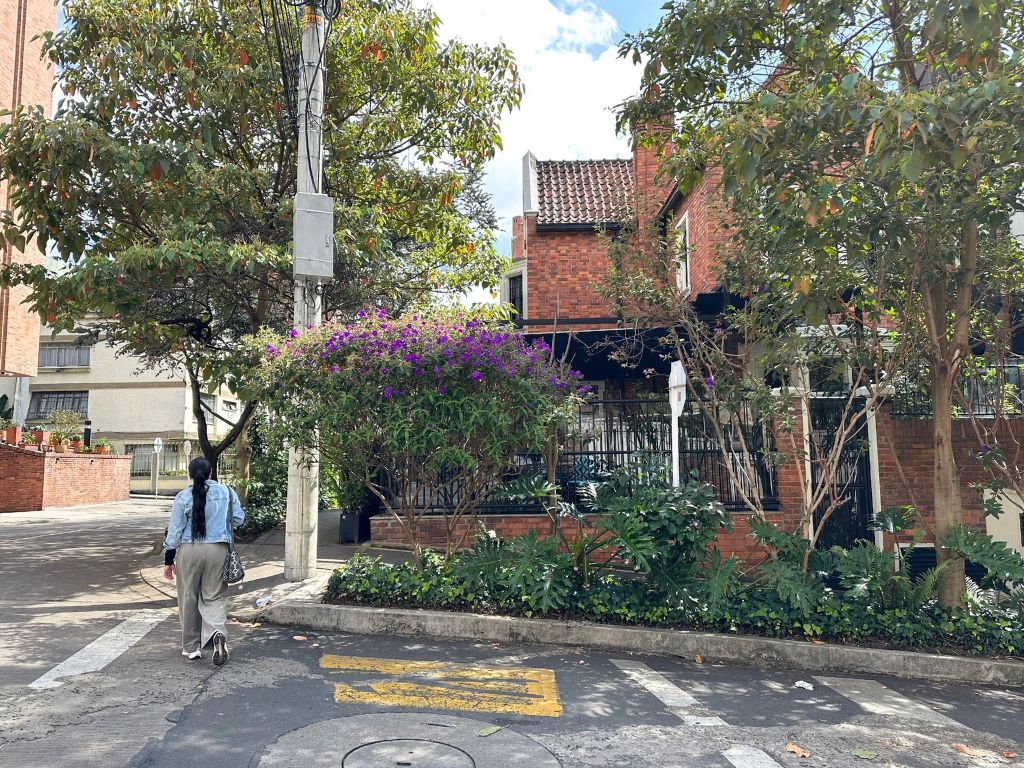
This is where I stay every time I come to Bogotá. These three small neighborhoods concentrate Bogota’s best gastronomy: signature restaurants in Zona G (“G” for Gourmet), specialty cafés, and boutique hotels in the English houses of Quinta Camacho.
The atmosphere is livelier and more authentic than in the neighborhoods north of the city, like Parque 93 and Zona T. Moreover, La Candelaria is only 20 minutes away by taxi.
In terms of safety, it’s more reassuring than La Candelaria at night, but a bit less than Parque 93: there are just a bit fewer people and less surveillance than in the chic north, so keep your reflexes sharp at night.
Besides, Chapinero is huge and, in a few streets, the atmosphere changes quickly. Beyond these three neighborhoods, there’s really not much to see. No need to venture further.
At night, take an Uber as soon as there are no longer many people outside, especially in Chapinero Alto, a residential area that empties out quickly once night falls.
At the restaurant, I also recommend keeping your phone in your pocket: fake vendors sometimes go from table to table.
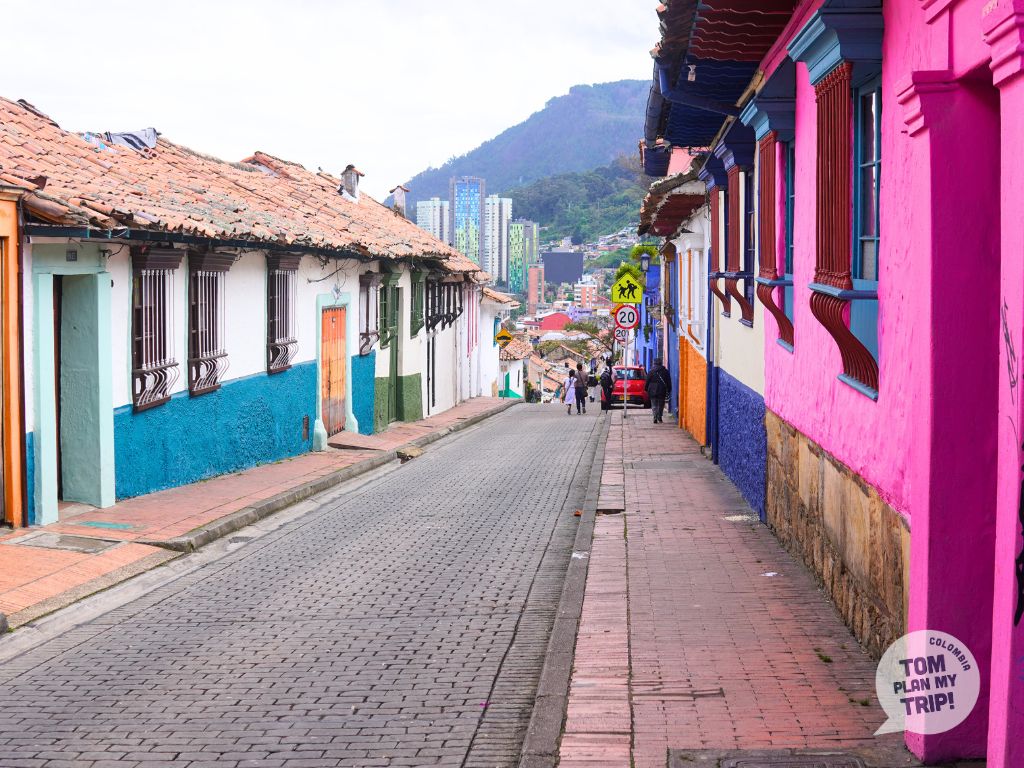
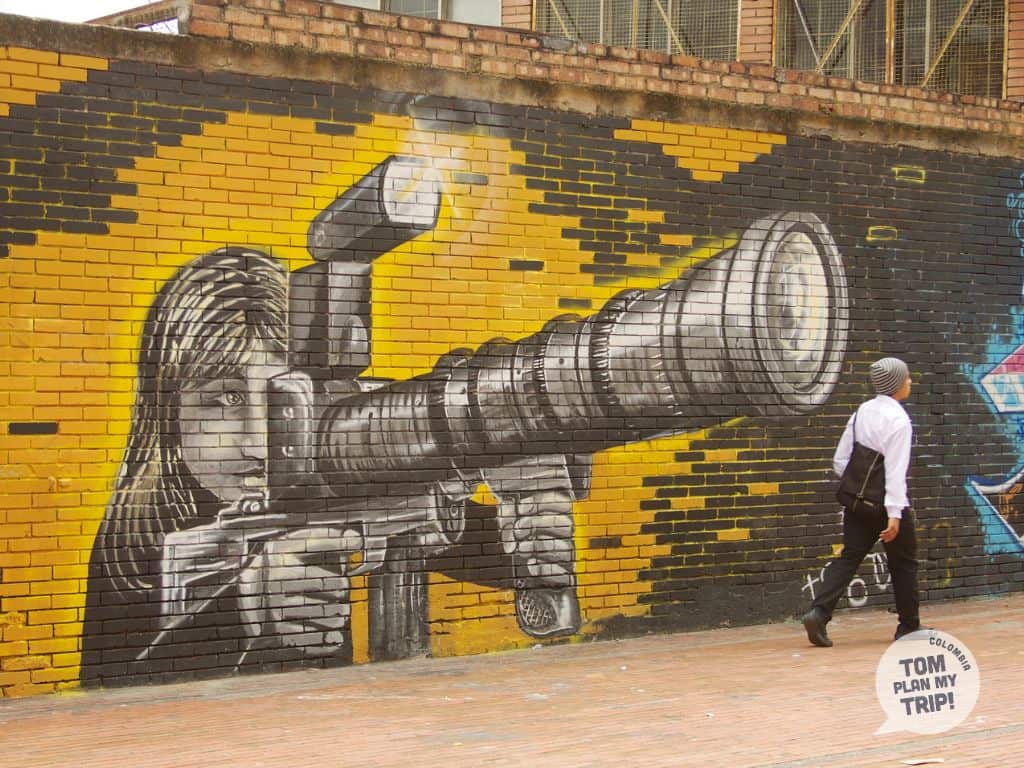
The historic center is a must-see, with its colorful facades, beautiful graffiti, museums, and its immense Bolívar Square.
Busy during the day with tourists, students, and street vendors, the neighborhood is noisy and disorganized, but authentic.
But after 9 PM, the restaurants and shops close, the poorly lit streets empty, police presence is much weaker than during the day, and the neighborhood, surrounded by poorer areas, becomes less reputable.
I never sleep there: I prefer to stay further north and come by Uber. However, this neighborhood has a convenient side for visitors who are only coming for one or two nights in Bogotá, given its proximity to the main points of interest in the city, or if your budget leads you to choose a hostel in the area. Just exercise caution. Take a rideshare as soon as night falls and don’t linger in front of your accommodation.
Similarly, the neighboring areas, La Macarena, Teusaquillo, and La Merced, are increasingly trendy during the day, with their bars and restaurants, but I do not recommend walking around there at night.
In Bogotá, the most common risk for a traveler is snatch theft: the phone is the primary target, but so are bags, chains, or cameras, often stolen by the rear passenger of a motorcycle. It’s quick, and it happens everywhere, even in upscale neighborhoods.
Colombians have a golden rule when it comes to safety: “No dar papaya”, in other words, don’t make yourself an easy target.
For this, you just need to apply a few simple actions:
- Look around you before taking out your phone, and move away from the road or enter a store.
- Hold it firmly, and never put it in your back pocket.
- Wear your bag crossbody, across your chest, or your backpack in front if there are crowds.
- Dress properly, but simply, and leave your jewelry, watch, and other valuables at the hotel.
And if someone threatens you, do not resist: your belongings are not worth your life.


© Tomplanmytrip
Your Signature Journey: fall in love with Colombia as a family
Which adventures will your family love? Is it really right for everyone? Is it safe? Is it too touristy? Is it really worth it? How many days should you plan?
Guessing and hoping you made the right call — sometimes that works. But not always.
And I won’t even get into the stressful surprises that force you to make some changes mid-trip.
Look, we’ve been doing this for years — and if you check our reviews, you’ll see we know what we’re doing.
Enjoy the trip instead of carrying the weight of it. Tell us what you love, and we’ll handle the rest.

© Tomplanmytrip
TRANSPORTATION IN BOGOTÁ
Get around without unpleasant surprises.
Practical and inexpensive, Bogotá‘s yellow taxis have a bad reputation. I have taken hundreds of taxis in Colombia without ever having a problem, except for a few overcharges. In Bogotá, they are much more frequent: the meter displays “units,” not a price, and additional charges are added. An official conversion table of units and prices must be attached to the back of the passenger seat.
As a simple precaution, in Bogotá I never hail a taxi on the street. This helps avoid unpleasant surprises, including the “paseo millonario”, rare but well-known here: the driver’s accomplices get in along the way and force the passenger to withdraw money from an ATM.
My reflex: I ask the hotel or restaurant to call me a taxi. At the airport, I only take an official taxi, at the counter or in the authorized queue. Or, more simply, I use an app (Uber, Didi, or Cabify).
Before getting in, check that the license plate is visible on the outside, that it matches the one on the inside, and that the driver’s card is displayed. During the ride, keep an eye on the route and avoid falling asleep.
Bogotá is a huge city: Uber is simple, inexpensive, and safe for getting from one neighborhood to another; the app tracks the ride. Once night falls, it becomes a reflex.
The legal status of this app remains unclear in Colombia. Nothing to worry about: in practice, only drivers risk a fine. So don’t be surprised if your driver asks you to sit in front, just to avoid attracting authorities’ attention.
Before getting in, compare the license plate, the model, and the driver’s photo with what the app displays, because the car doesn’t have an Uber logo.
Also activate the PIN code: a 4-digit code you give the driver when getting into the car. They must enter it on their phone to start your ride. It guarantees that you’re in the car you reserved.
If you need reassurance, share your ride with someone close during the trip.
Transmilenio is a network of articulated buses that operates like an open-air subway: closed stations and turnstiles at the entrance. It connects La Candelaria to the northern neighborhoods for almost nothing, and its dedicated lanes allow you to escape the traffic jams.
However, it is often crowded and confusing if you’re not used to it: lines coded by color, letter, and number, express buses that skip stations, and a network disrupted by subway construction.
To use it, you need to buy a TuLlave card at an official sales point. In some stations, you can also pay directly with your contactless bank card (Visa or Mastercard).
Rush hours are to be avoided: on weekdays, from 7 AM to 9 AM and from 5 PM to 8 PM, these are the favorite times for pickpockets who take advantage of the crowd. If you take it, keep your bag in front of you, your phone in a closed pocket, and don’t stand close to the doors.
In short, I advise against taking the Transmilenio if you’re only in Bogotá for a few days.

© Tomplanmytrip
GOING OUT IN BOGOTÁ
Avoid the pitfalls of Bogotá’s nightlife.
You have surely heard of scopolamine: a drug without taste or smell, slipped into a drink or food, which makes the victim compliant long enough to rob them (phone, bank cards, codes), then erases their memories.
The most common trap is through dating apps, like Tinder: an attractive profile, often fake, suggests having a drink or coming to your hotel, and that’s when the drug ends up in your drink. I advise you to avoid these kinds of apps.
But the risk doesn’t stop at apps: it’s also there when you go out in the evening. In Bogotá, bars and clubs in the upscale neighborhoods are not spared; quite the opposite. Never leave your drink unattended, refuse those that are offered to you, and beware of strangers who are too forward or too friendly. Very attractive women often serve as bait.
If you feel strange (confused thoughts, memory gaps), go see a guard, or a friend if you’re not alone; tell them you think you may have been drugged and don’t leave with anyone you don’t know. If you feel in danger, call 123, Colombia’s universal emergency number.
In Bogotá, as in all large Colombian cities, the rule is simple: do not buy drugs.
Buying is illegal: you can get arrested and end up with big trouble. Plus, looking for a dealer puts you directly in contact with an environment you are better off staying away from.
Not to mention you never know what you’re consuming: travelers have ended up in the hospital.
A tip in passing: never carry a bag or a package for someone and keep an eye on your luggage, as trafficking is severely punished in Colombia.
Finally, don’t forget that drug trafficking has done a lot of harm to this country, and many Colombians look unfavorably on drug tourism. Proud of their country, they want to show its true face above all.
Between the dance, the music, and the warmth of the Colombians, the opportunities to meet people are plentiful in Bogotá. The Bogotá women are reputed to be more reserved at first, but also more independent.
My advice: prioritize face-to-face meetings. If you still use an app, be wary of profiles that seem too perfect; photos are sometimes stolen or AI-generated.
Also know that the trap doesn’t necessarily close at the first meeting: some scammers take the time to earn your trust over several dates before robbing you, often by drugging you.
So, as long as you don’t know the person well, don’t bring them to your hotel and don’t go to their place. Meet in a public place. Arrive and leave on your own, and tell someone close, giving him the name of your contact, the location, and the app. And if someone asks you for money or intimate photos, cut it off.
Regarding prostitution, it is not penalized for adults, but it is often in the hands of pimps and trafficking networks, and linked to scopolamine thefts. And any relationship with a minor constitutes a crime that is heavily punished.
Bogotá has nightlife that rivals Medellín‘s.
The most popular addresses are found in the Zona Rosa, around the Zona T and Parque 93, where you’ll find chic bars and rooftops, while Chapinero attracts more Bogotanos and the LGBTQ+ community.
And here the party goes on late. To make sure it remains a good memory, a few precautions are necessary:
- Drink in moderation, especially in the first few days – at 2,640 meters, your body needs to get used to the altitude, and alcohol slows down this adaptation.
- Go out in groups and never leave a club with someone you just met.
- Check your bill (club entry is often not free).
- Finally, before leaving the club, order an Uber, even if you only have a few streets to go, then go straight home.
In Bogotá, walking at night, for example, to go from a restaurant to a bar, is not impossible as long as there are plenty of people around you. Otherwise, it’s a no, without exception: that’s my rule.
As soon as the sidewalks empty out or lighting becomes scarce, order an Uber, even for just a few blocks. Also avoid going home alone late at night.
A useful reminder: in case of an attack, there’s no need to play the hero.

© Tomplanmytrip
WITHDRAWING MONEY, EXCHANGING, AND PAYING IN BOGOTÁ
Withdraw safely and limit fees.
You will need cash in Bogotá, and the easiest way to get it is to withdraw money from an ATM (“cajero”).
Choose ones inside a bank, a shopping mall, or an airport: there are security guards, and the risk of them being tampered with is lower.
Withdraw during the day, avoid isolated machines on the street, and cover the keypad when you enter your code. If someone offers you help, politely refuse. If you withdraw in a closed booth, make sure the door is closed behind you and don’t let anyone in.
Put away your money before leaving: some thieves watch customers leaving an ATM to follow them, a well-known technique in Bogotá, called « fleteo ».
If you need to withdraw a large amount of money, go directly to your accommodation afterward to avoid walking around with it.
If the bills don’t come out, immediately notify the branch (if you’re inside and it’s open) and check with your bank to make sure you haven’t been charged.
Traditional banks abuse payments abroad: between their fees and the exchange-rate margin, it’s not uncommon to pay 5-10% more.
To avoid this, I’ve been using an online bank, N26, since 2018; Revolut or Boursorama Ultim also work very well.
On site, be careful with the conversion offered by the ATM or the restaurant terminal when paying the bill: refuse it and always choose to pay in pesos. Sometimes a server might make this choice for you. So, watch the screen.
Favor Banco de Bogotá ATMs: they allow you to withdraw larger amounts in a single transaction, which reduces fees.
For cash, an ATM is more advantageous than a currency exchange office. If you still want to go through an office, choose a licensed one and ask for a receipt. At the airport, only convert the bare minimum, and never on the street. You can also go to the currency exchange office in a shopping center.
Like everywhere tourists go, some sellers apply what is called the ” gringo tax“: an inflated price simply because you are a foreigner, especially if no price is indicated.
To avoid it as much as possible, I always ask for the price before ordering, buying, or booking an activity, and I am wary of anything that seems free: in the end, everything has a price.
In restaurants, the law requires displaying prices on a physical menu. When you get the bill, you will often be asked to add a tip (propina) of up to 10%: it is optional, and the server must ask for your consent before including it.
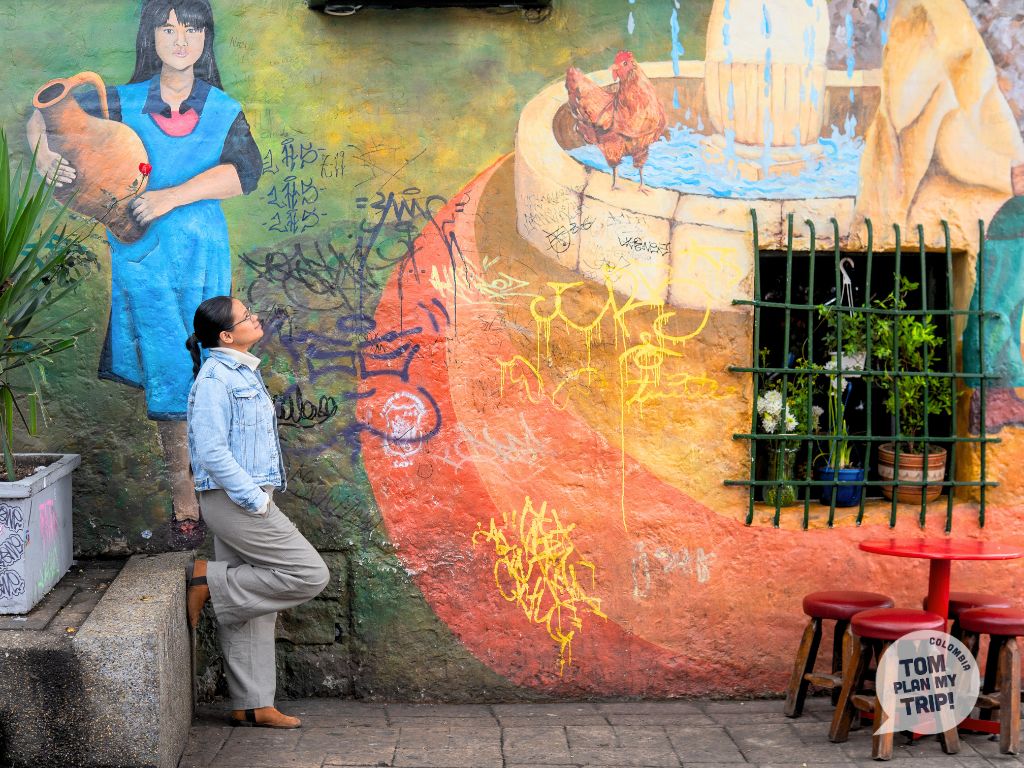
Before paying by card, I always check the total of the bill and the amount displayed on the terminal. And if I pay in cash, I check the change given back.
© Tomplanmytrip
HEALTH IN BOGOTÁ
Altitude tips and where to get medical care.
In Bogotá, the tap water is drinkable and regularly monitored by the health authorities.
If you have a sensitive stomach, I still recommend drinking bottled water for two reasons. In some old buildings, pipes or tanks installed on the roof can alter the water’s quality. And the simple change in composition is sometimes enough to upset you in the first few days.
A good habit is to ask your hotel about it. You can also bring a filtering water bottle in your luggage — plus, you reduce plastic use.
For fruit juices bought on the street, asking the vendor if they are made with bottled water won’t guarantee anything. The safest option is to choose a busy stand that prepares the juices in front of you.
If you want to be sure, order your juice with milk and without ice (“en leche, sin hielo”). Anyway, the vendor will probably ask you: “¿en agua o en leche?”
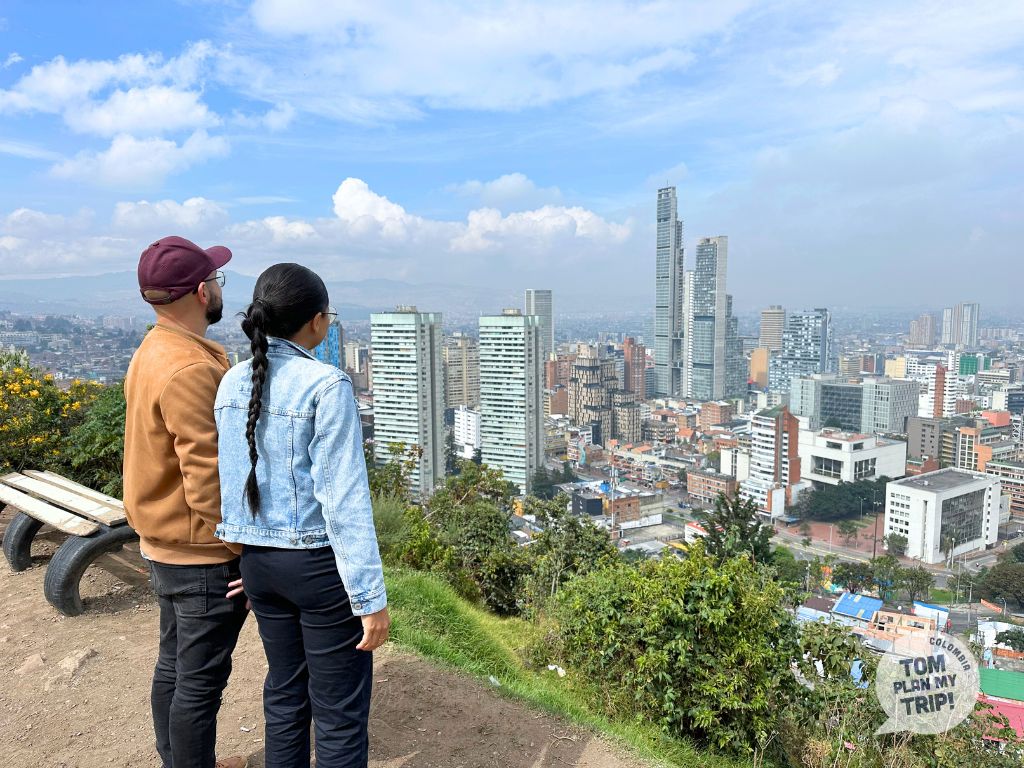
Perched at 2,640 meters above sea level, Bogotá is among the highest capitals in the world, and some travelers experience altitude sickness, or “soroche” as Colombians call it: headaches, dizziness, shortness of breath, nausea, or extreme fatigue.
The symptoms often appear within the first 36 hours, with a peak on the second day, just when you think you are acclimated, regardless of your physical condition.
My advice: dedicate your first days to relaxed visits, without intense effort, drink plenty of water, eat light — as much as you can 😉 — get good nights of sleep, and take it easy with alcohol. Save the climb to Monserrate, which peaks at 3,152 meters, for the end of your stay.
If you are prone to altitude sickness, talk to your doctor before departure: they can prescribe appropriate treatment. On site, don’t hesitate to consult if symptoms worsen.
In Bogotá, the sun is deceptive. Close to the equator, the Colombian capital gets an almost vertical sun all year round, and at 2,640 meters altitude, the atmosphere filters the rays less. Result: the city regularly records an extreme UV index.
The trap is that the air is cool and the sky is often overcast: you don’t feel anything, so you don’t suspect, while you are being bombarded with UV.
I recommend applying a sunscreen with a high protection factor and reapplying it regularly. Also wear a hat and UV-protection sunglasses, especially in the middle of the day or if you climb Monserrate, another 500 meters higher.
If you get sick or injured in Bogotá, you will be well cared for. It is one of the best-equipped cities on the continent with medical infrastructure, but I recommend choosing a private facility. Public hospitals are often crowded, and the wait can be very long.
Bogotá has excellent private clinics, located in the neighborhoods where you might stay: the Clínica de Marly, in Chapinero if you are staying near La Candelaria, La Macarena, or Chapinero Alto; the Clínica del Country – well known among expats – a few blocks from Zona T and Parque 93; and the Fundación Santa Fe, near Usaquén, ranked among the best hospitals in Latin America.
In case of an emergency, call 123 for an ambulance; depending on traffic, an Uber might sometimes be faster. Remember to bring your insurance policy: in private facilities, you will be asked how you plan to pay.
Travel insurance is not mandatory to enter Colombia, but I highly recommend it. Your usual health insurance does not cover you here, and private clinics charge foreign patients directly, sometimes with an advance payment. With good insurance, assistance covers the costs and organizes your care. Call them before or as soon as you arrive at the hospital.
If you plan to be covered by your bank card, check its limits and conditions.
Warning: to enter certain national parks, like Chingaza — a classic day trip from Bogotá —, your travel insurance is not enough; you need specific accident insurance. The agency organizing the outing usually offers it.
© Tomplanmytrip
VISITS AND SHOPPING IN BOGOTÁ
The classics of Bogotá.
To ascend Monserrate, where the view of Bogotá is particularly beautiful at sunset — if there are no clouds — you have two mechanical options: the cable car, a suspended cabin offering a bird’s-eye view, and the funicular, a small train on the mountainside, with less of a view.
There is also a free pedestrian path, very popular with Colombians on Sundays. A staircase of 1,605 steps and about 500 m of elevation gain, up to an altitude of 3,152 m. Even if you are in shape, expect to quickly feel the lack of air.
I do not recommend it, as several cases of theft have been reported. Or take it on a Sunday, when there are lots of people.
If you really want to go up on foot, plan for good shoes, as the steps are uneven; take breaks and bring water. And stay on the marked trail. It is not recommended for pregnant women and those with heart, respiratory, or mobility issues.
It is open every day except Tuesday, from 5 AM to 1 PM for ascending and until 4 PM for descending. After that, you will necessarily have to go down by one of the means of transport.
In fact, I recommend taking the cable car, even if you have to wait a bit if there’s a line. And if there’s a crowd, watch your belongings.

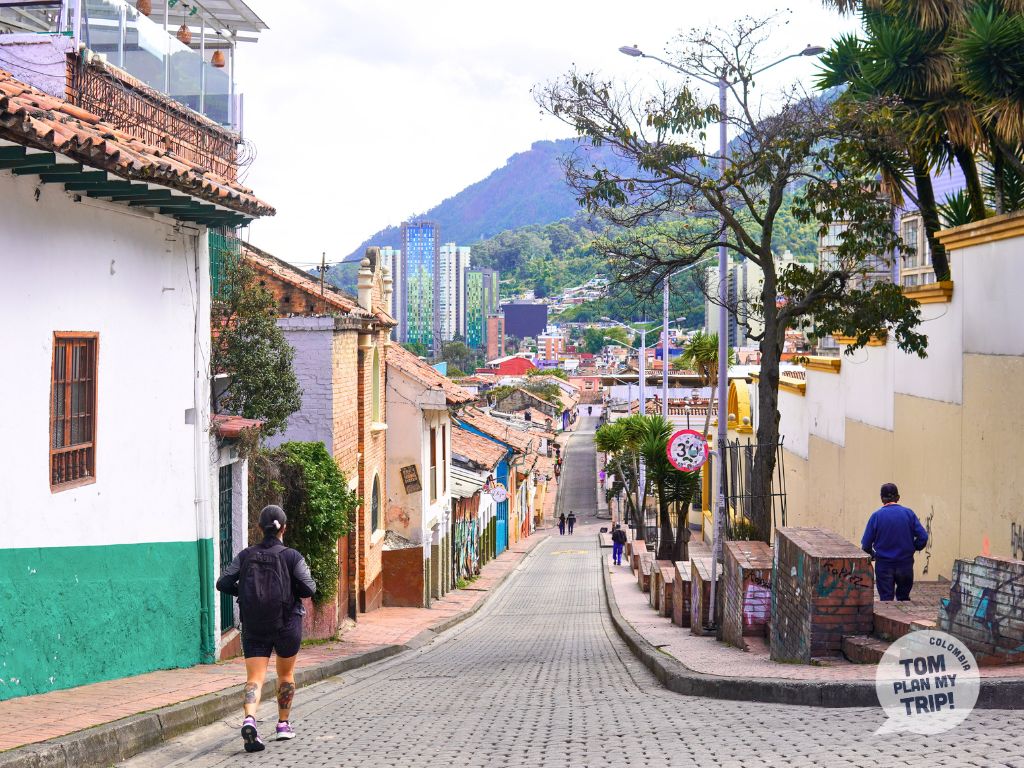
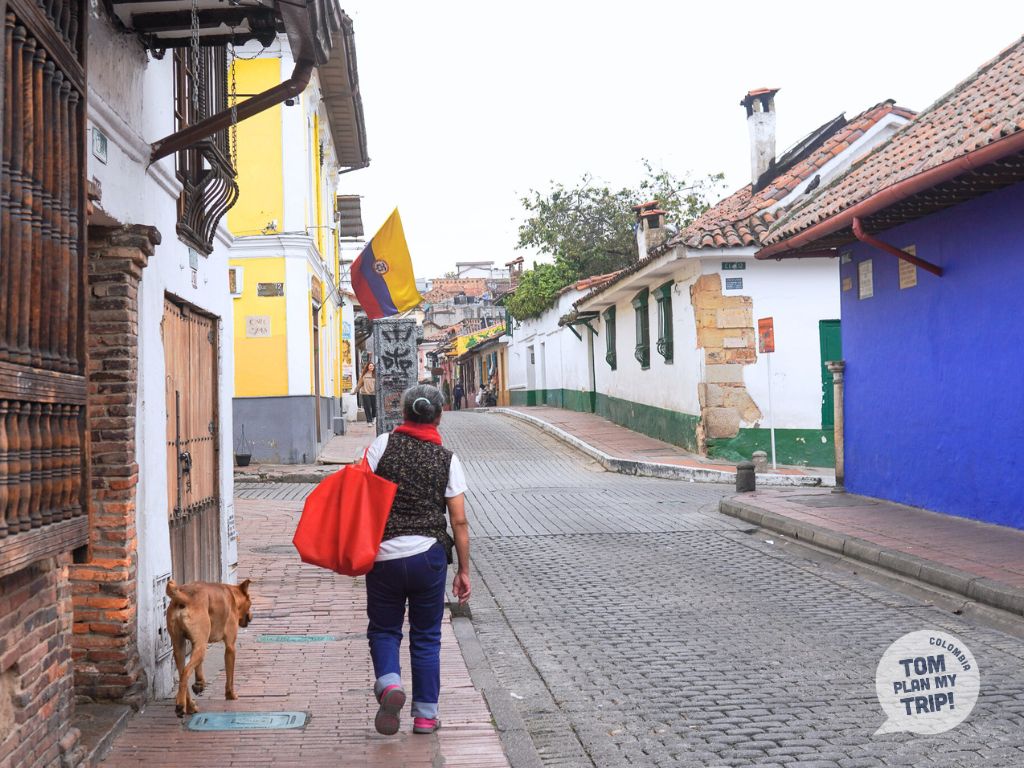
La Candelaria is Bogotá’s historic center: colorful colonial houses, cafés, street art, the city’s best museums, and Plaza de Bolívar. You will definitely pass through here. It’s also where you’ll encounter the most pickpockets, with its narrow streets, crowded sidewalks, and high tourist traffic.
The tips are simple. Dress casually and leave the jewelry at the hotel. Don’t put anything in your back pockets, carry your bag in front of you in crowds, and keep your phone put away when walking.
Also avoid stopping in the middle of the sidewalk with your nose on a map: plan your route before going out.
Outside the main streets, the neighborhood empties quickly, and even more so in the evening: at nightfall, take an Uber.
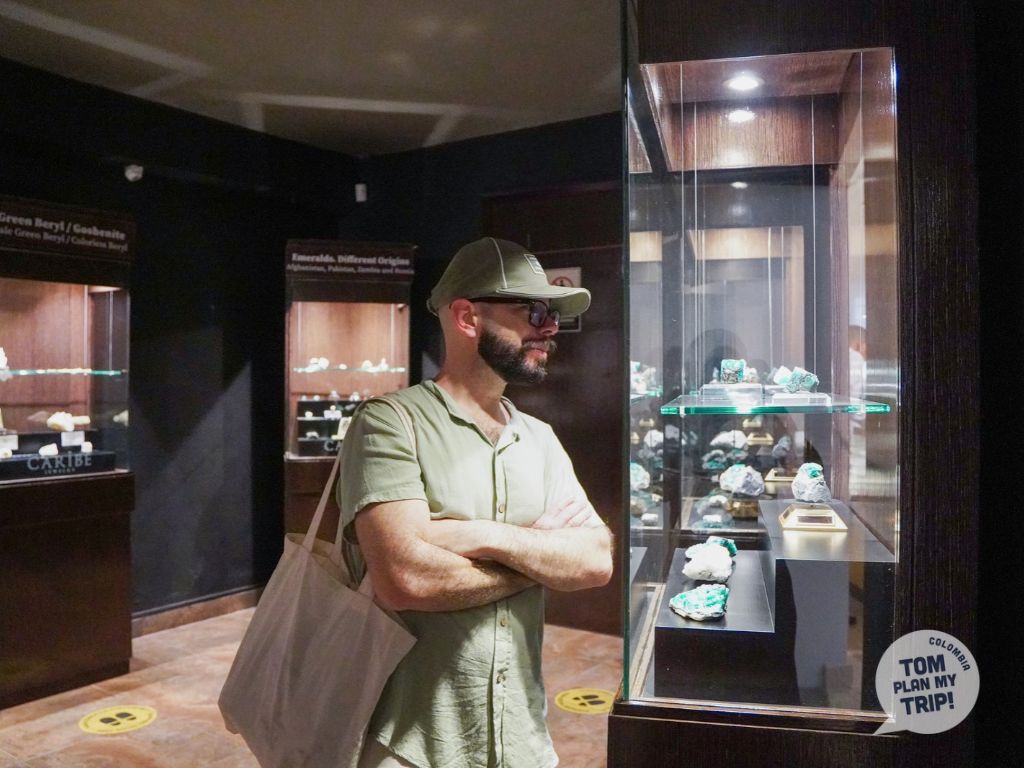
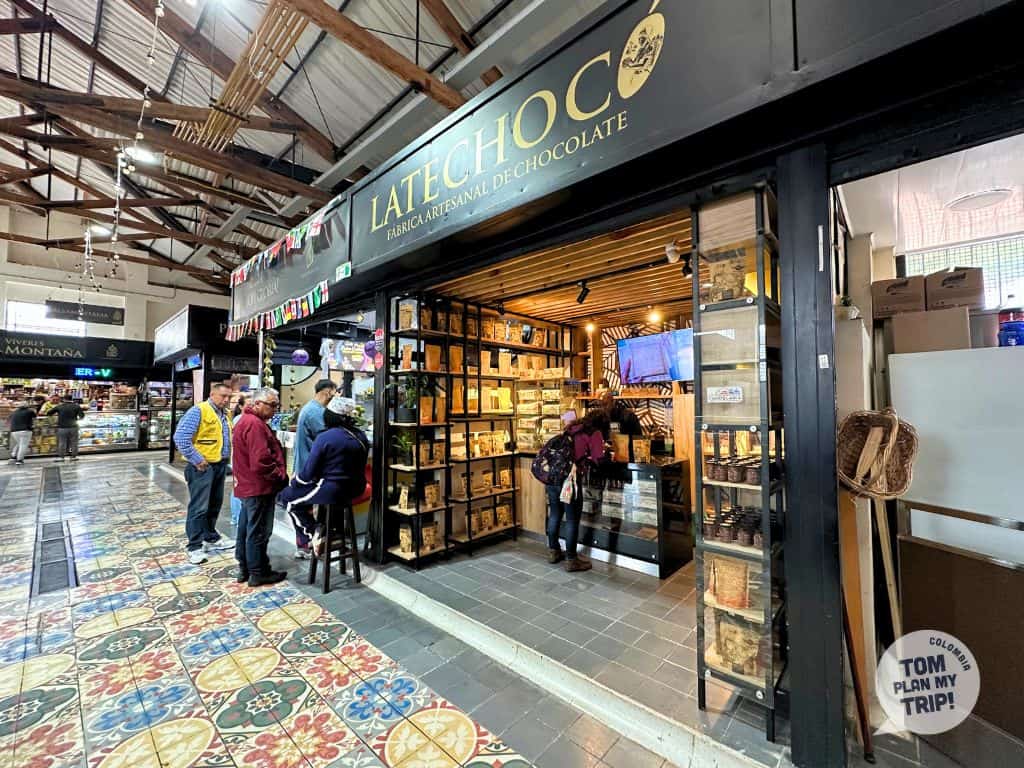
Colombia is the country of emeralds: the mines of Boyacá, north of Bogotá, provide the world’s most beautiful stones, and the Colombian capital is the major trading center.
The historic center has dozens of jewelry stores established on just a few streets, some of which have been around for more than a century. But trading extends well onto the sidewalk, hand to hand.
The rule to remember: never buy an emerald from someone who approaches you on the street. Fake stones are very well imitated, and even professionals get fooled by synthetic stones.
If you really want to buy one, go through a recognized jewelry store and demand a certificate of authenticity.
© Tomplanmytrip
THE FAKE POLICE OFFICERS SCAM IN BOGOTÁ
The scenario and the parade.
Two men approach you on the street, introduce themselves as police officers, and hold a laminated card. They are in plain clothes or wearing an outfit that imitates the uniform.
They announce a check: verification of papers, search for fake bills, investigation of a theft in the neighborhood. Then they ask to see your passport, your wallet, or to check your money. That’s when the bills disappear, or they tell you there’s a fine to pay on the spot.
This scam mostly happens where tourists are easy to spot: in Candelaria, on Avenida Jiménez, at the airport exit.
This scenario has two common variations: the accomplice, who pretends to be another traveler and gains your trust by showing his papers to the fake police. And the dealer trap: you’re sold drugs — you know you shouldn’t buy them — the “police” show up, and you pay to avoid trouble.
The rule is simple: you never let go of your wallet or your passport. A real Colombian police officer will not ask to inspect your money or count your bills. If they want to see your papers, hold them yourself to show them.
Also, leave your passport at the hotel and only carry a photocopy. That’s enough for a check.
A real police officer is in full uniform, with the insignia of the Policía Nacional and a badge with their name and number.
If the person who stops you is not in uniform, assume they are not a police officer. If you have any doubt, suggest going to the CAI, the nearest neighborhood police station, or call 123 to verify their identity. In general, that’s enough to make fake police officers flee.
© Tomplanmytrip
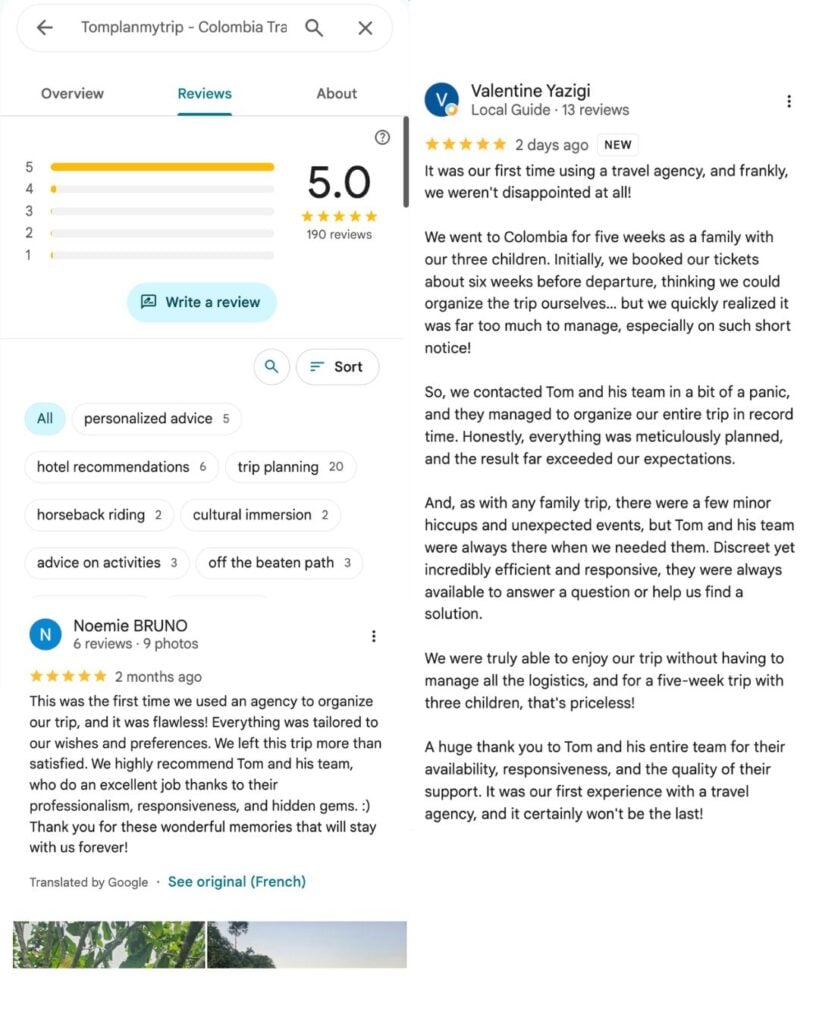
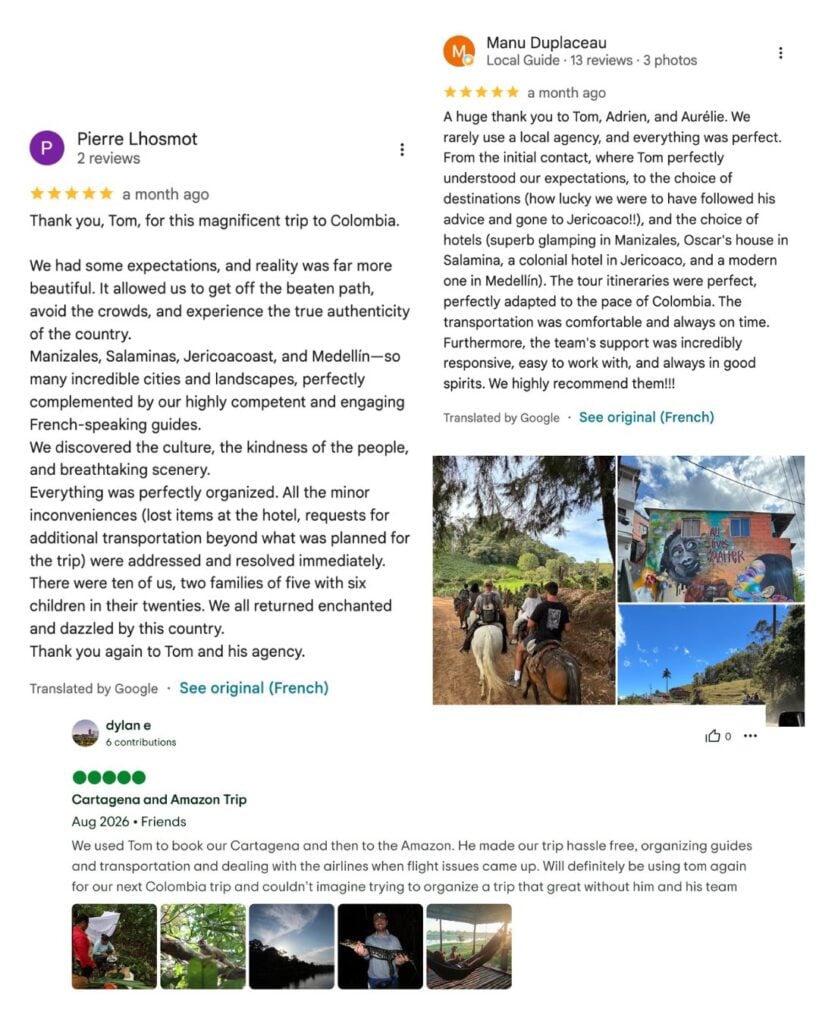
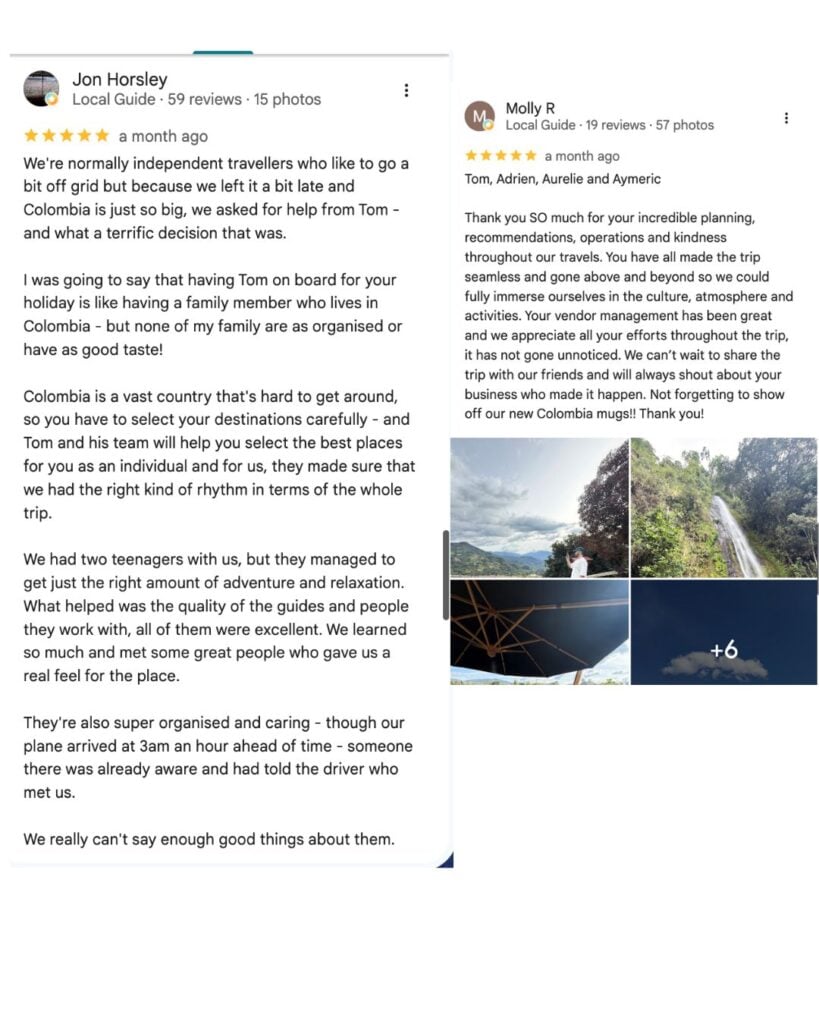
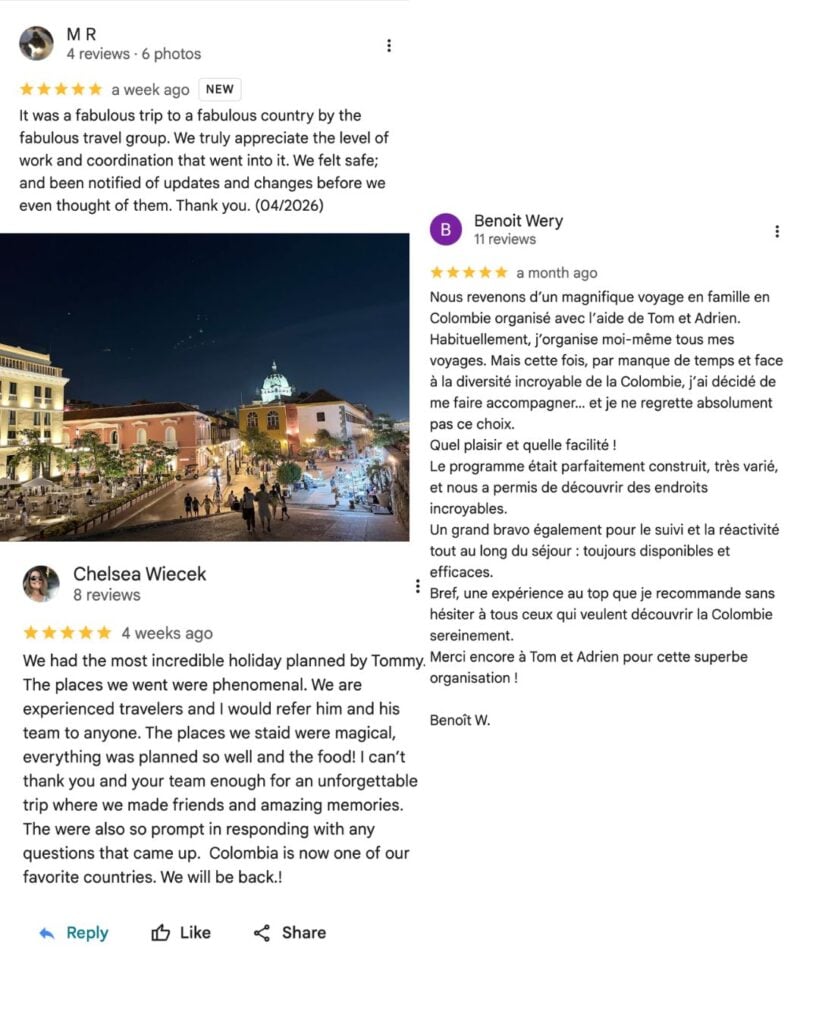
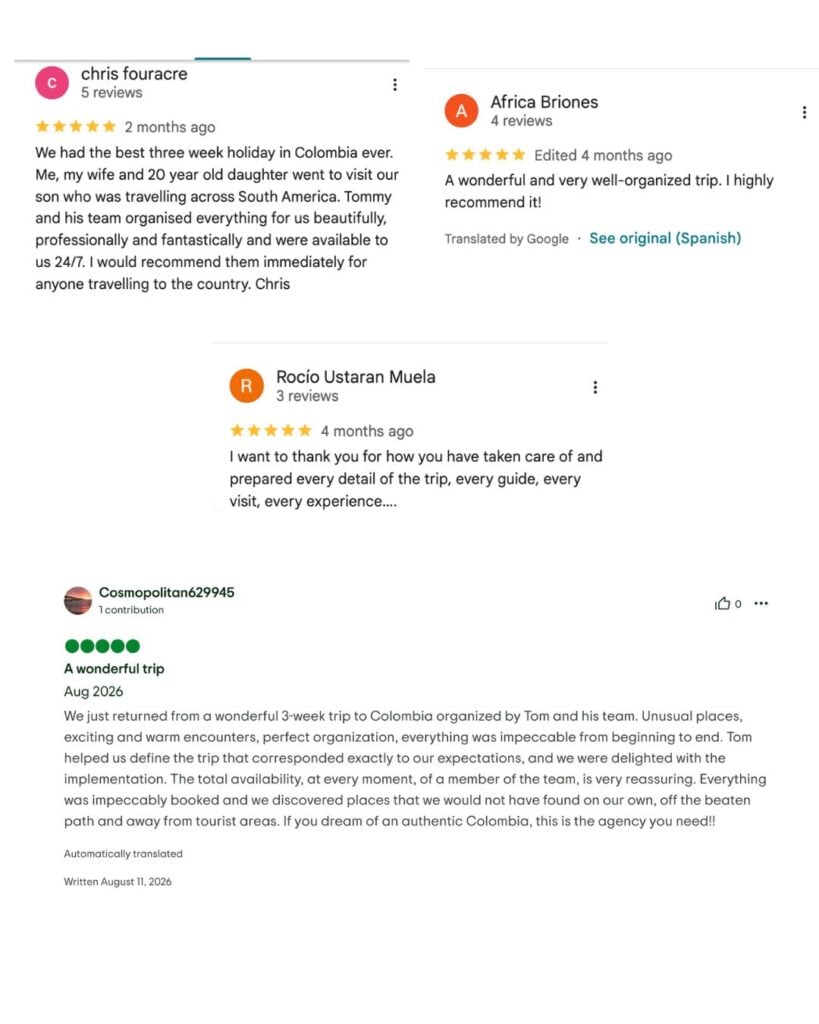
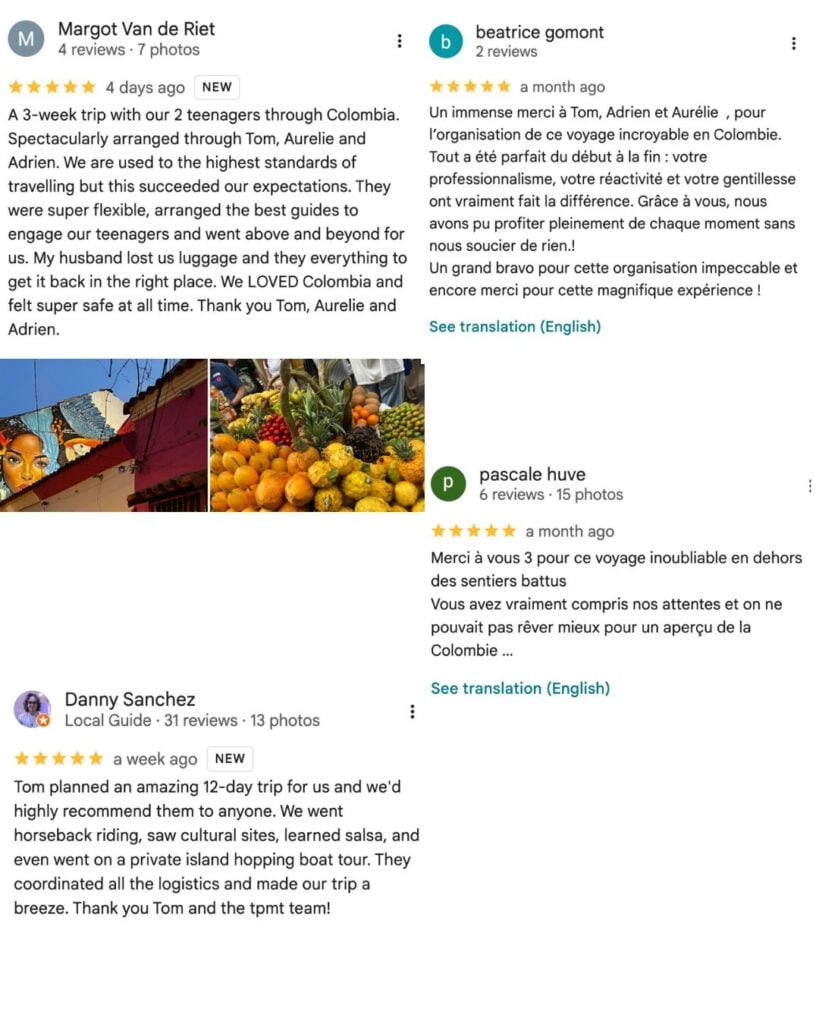
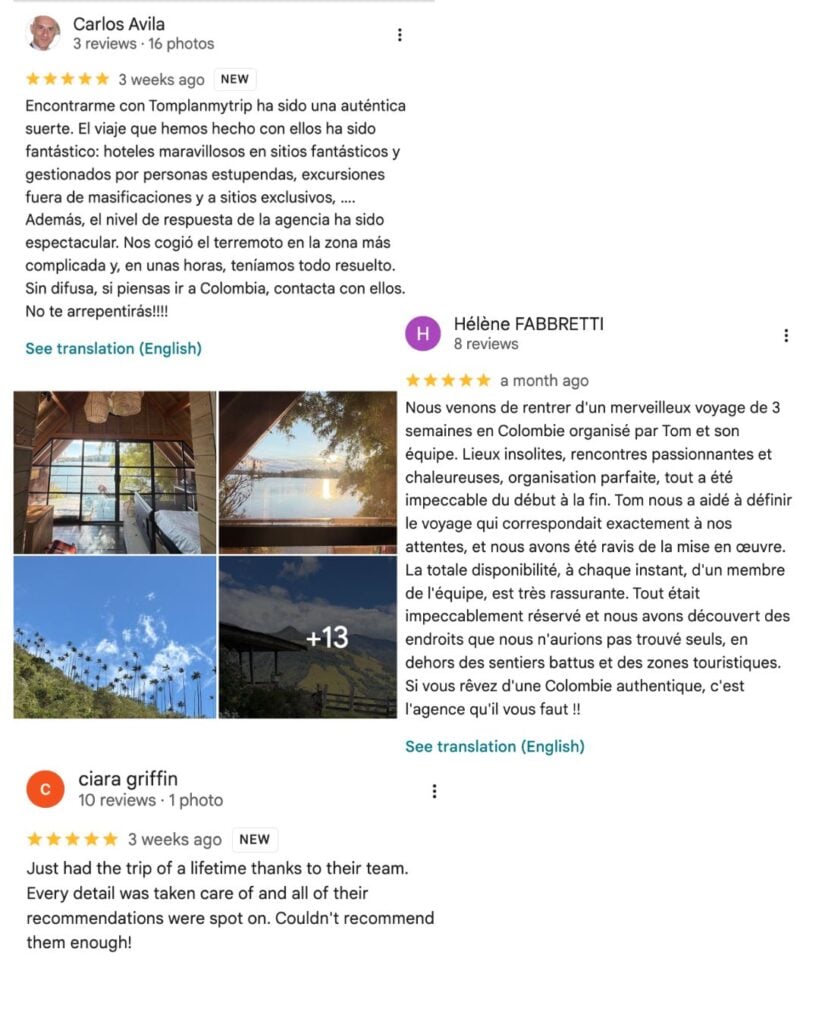
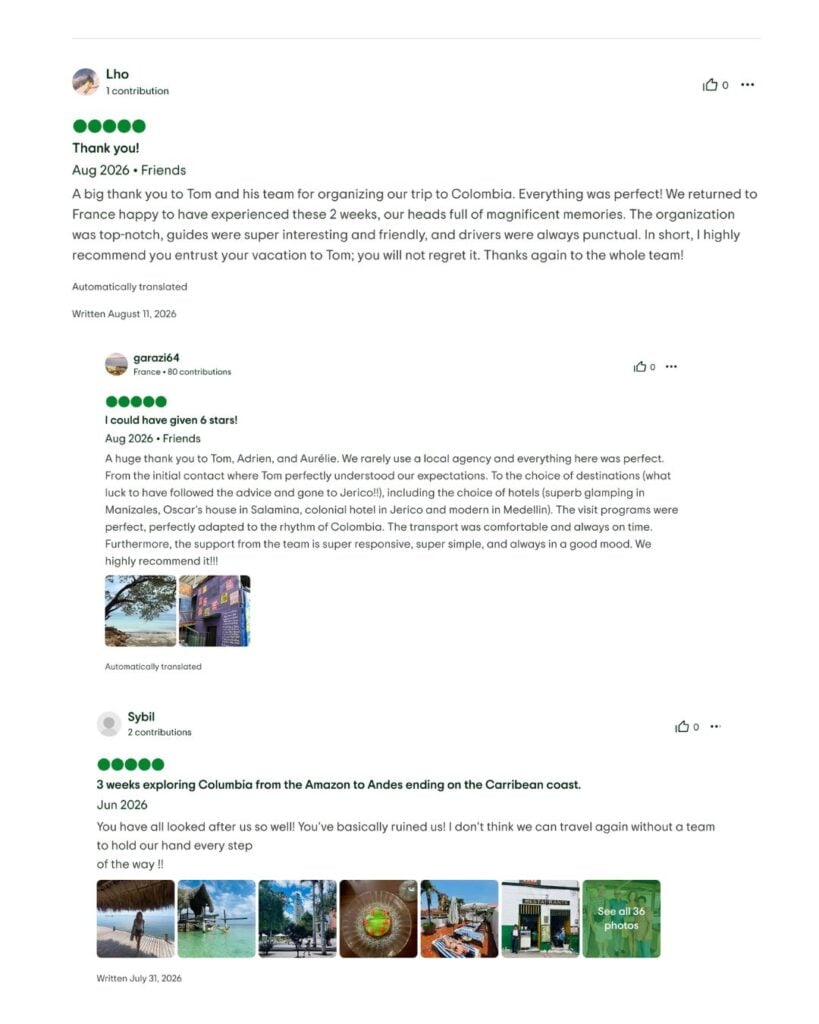
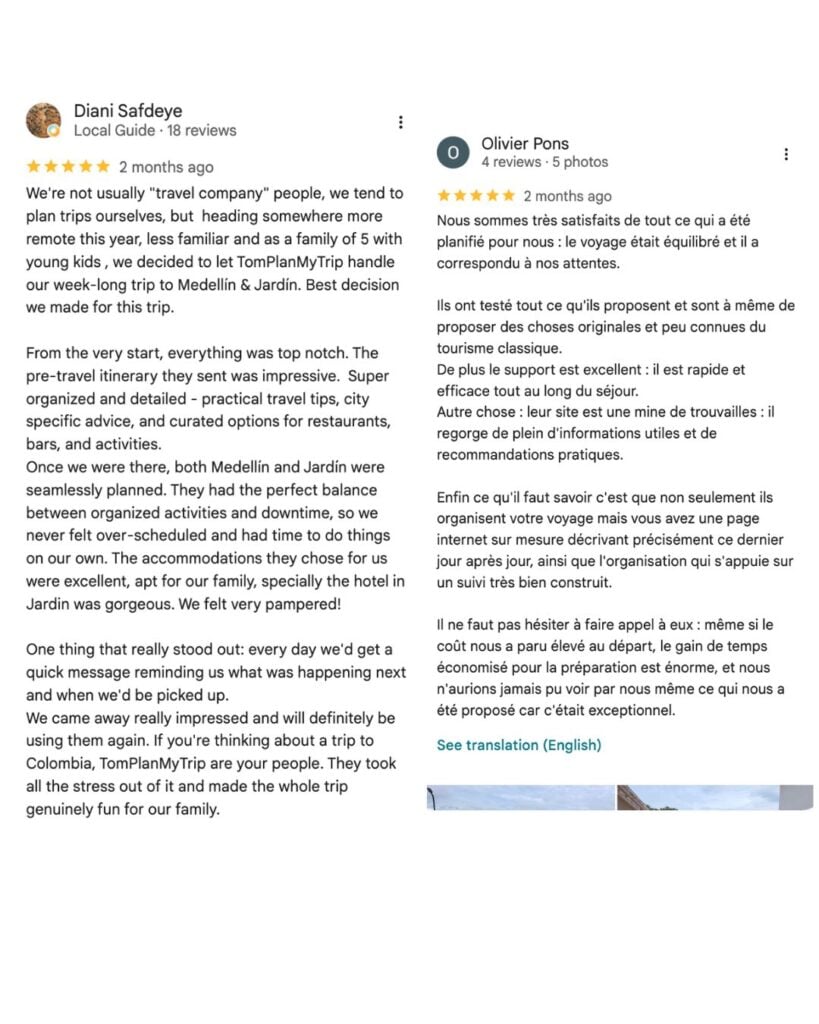
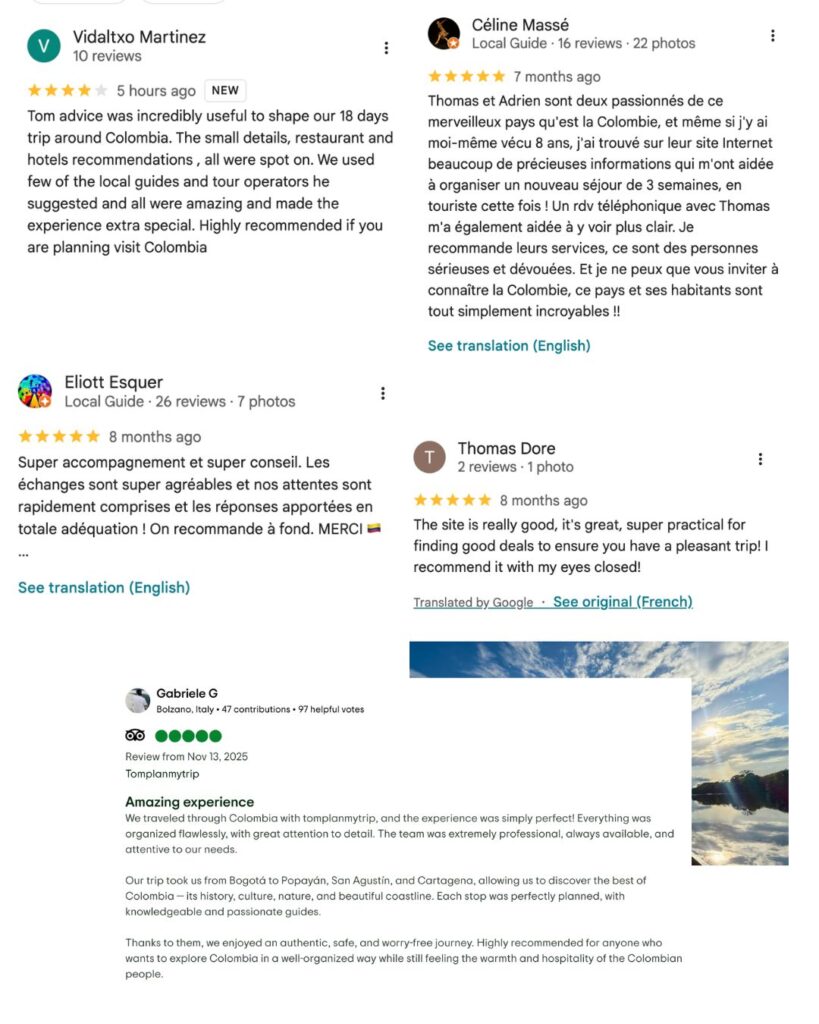
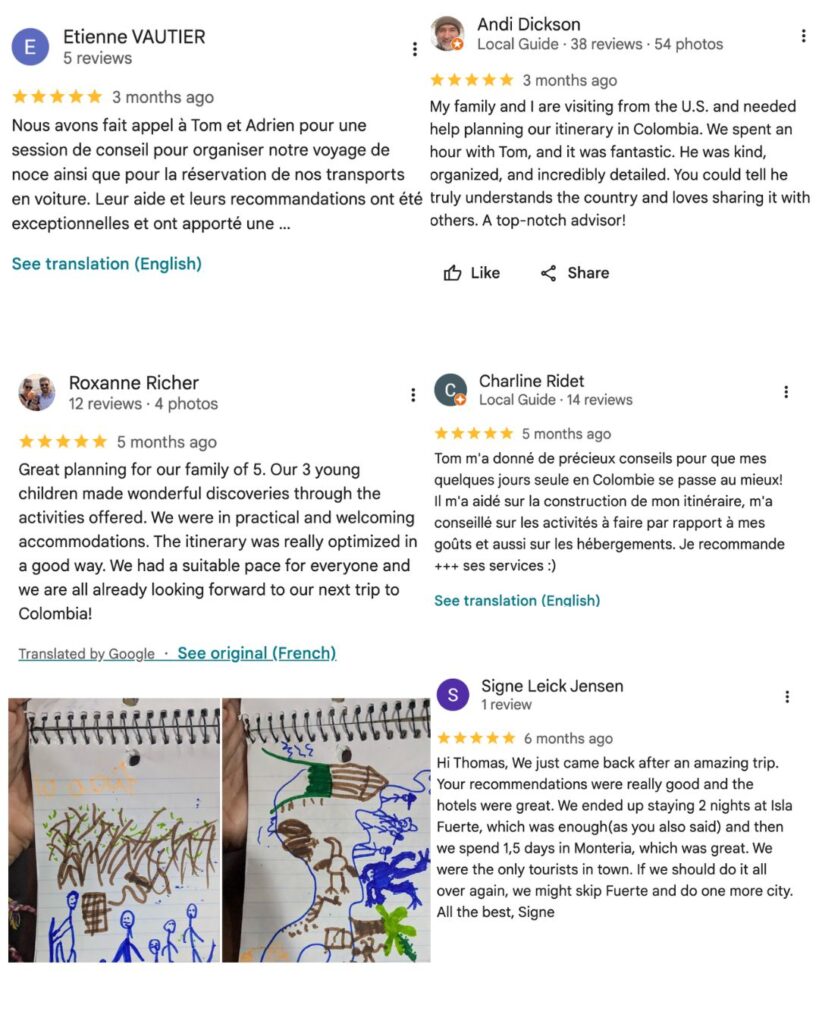
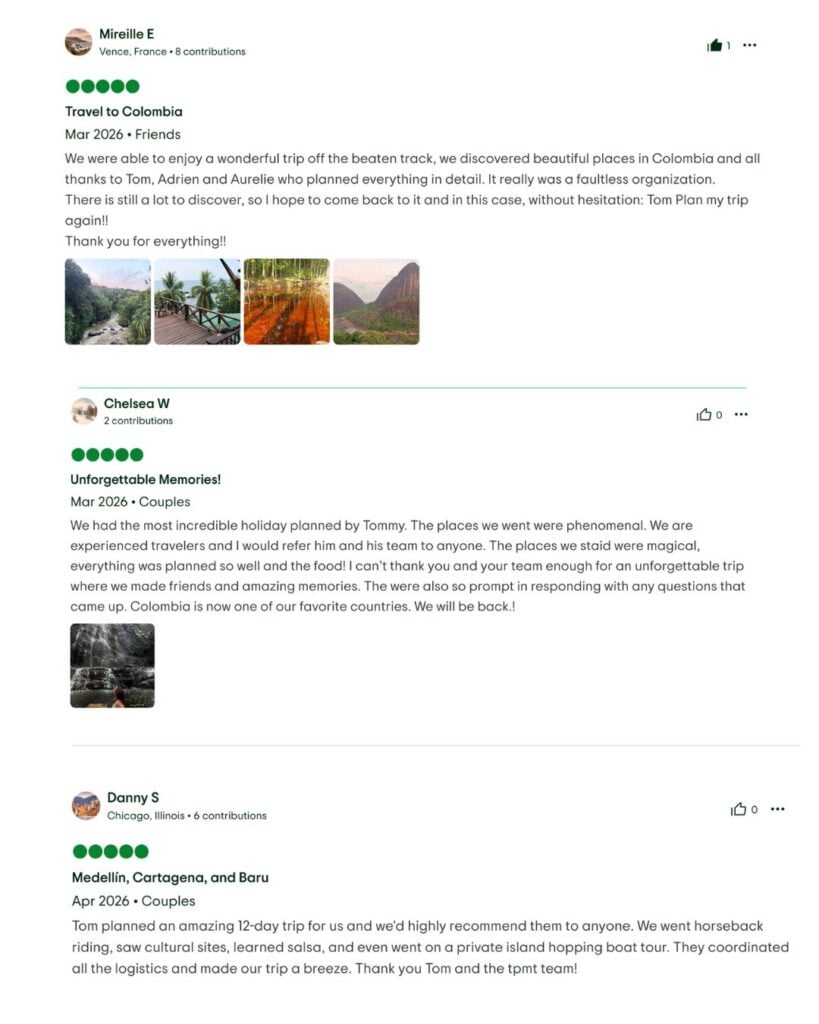
+185 five-star reviews on Google Maps

No more cookie-cutter trips made for the average family
“Usually, I don’t go through a travel agency. But for Colombia, I needed help — and this agency transformed my experience in this country.”
That’s the kind of review our travelers leave us. Instead of second-guessing yourself and putting off decisions, let us plan your trip. Unforgettable memories guaranteed.
What type of trip suits you?
Every trip is unique, but you might see yourself in one of these themes.
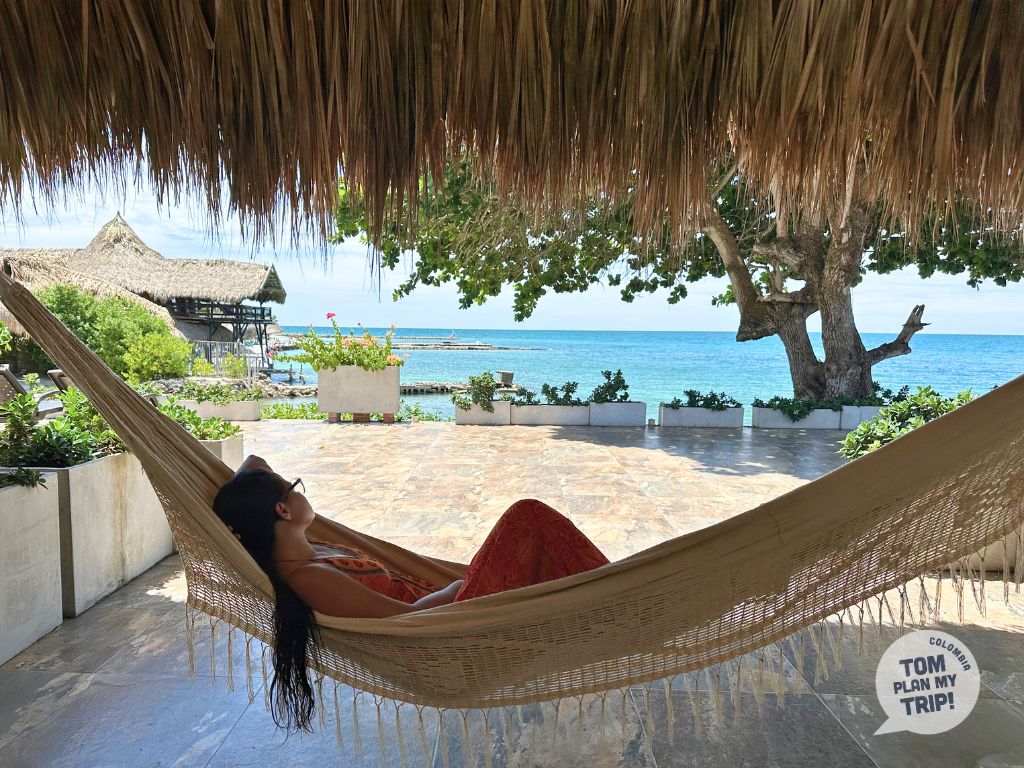
LAID-BACK
Your vacation doesn’t have to be 100% beach or 100% exploring. With our 11 years in Colombia, we plan your ideal trip so you can discover the country without rushing around. The best way to travel and recharge at the same time.
Learn more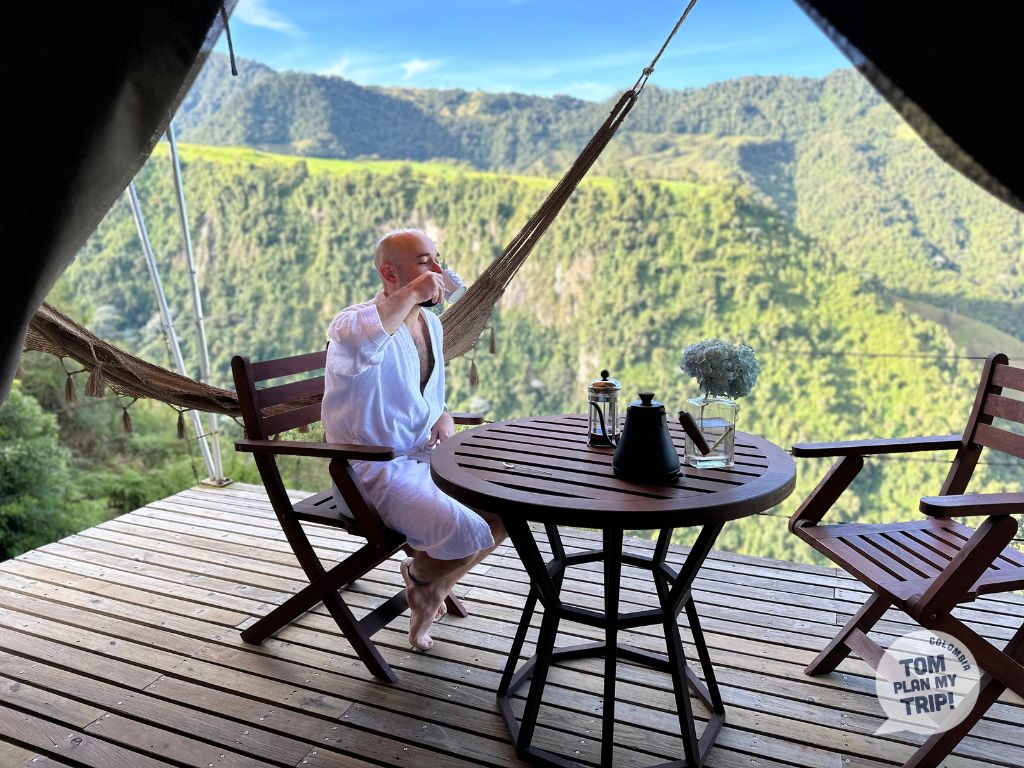
PREMIUM
You love beautiful places to stay and extraordinary experiences, but not cookie-cutter luxury? Drawing on our 11 years of exploring, we plan a premium trip so you can experience the most spectacular side of the country, in the best possible conditions.
Learn more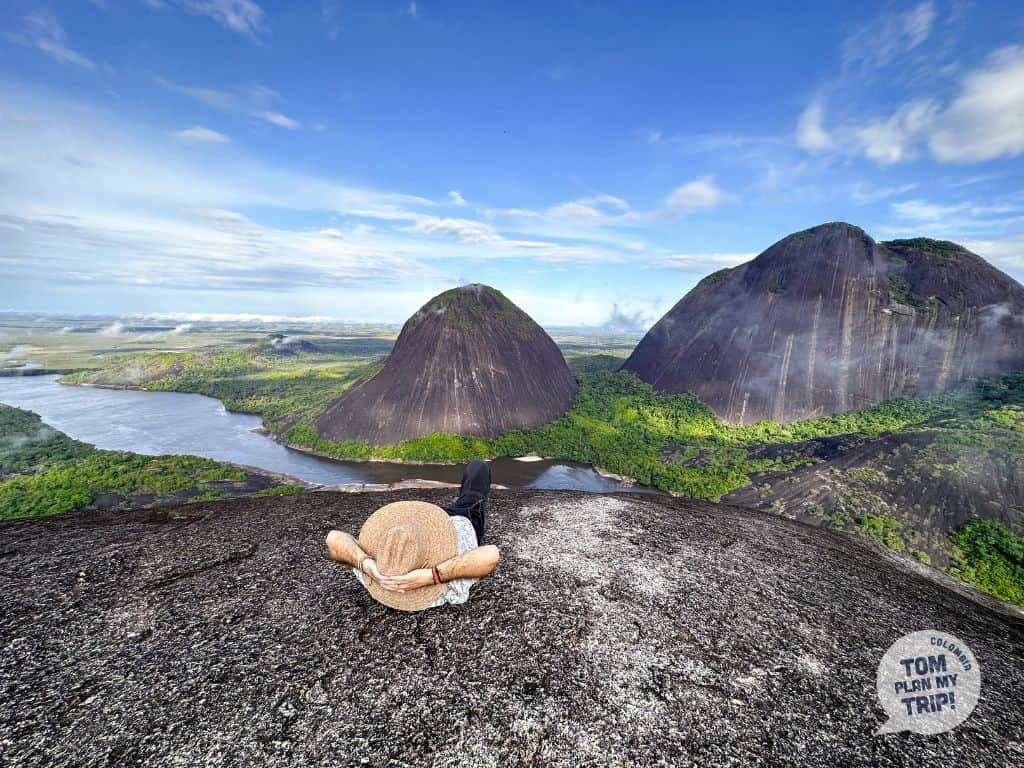
ADVENTURE
Not interested in the Colombia everyone already knows? Set off exploring with your loved ones and share unforgettable moments, with that feeling of being on another planet. All backed by our 11 years exploring the country.
Learn moreWhat our clients say
Our articles on Bogotá
Select a Region of Colombia


Western Caribbean Coast
Colombian Destinations Listed Alphabetically
Places from A to I
Places from J to P
Places from R to Z
Follow us on Instagram!


Our secret to actually enjoying your Colombia vacation
Colombia is twice the size of France. There’s no point trying to see it all in 15 days. Our trips distill 11 years of boots-on-the-ground exploration into the essentials: the very best of the country, without the stress of racing around.
