
The Birds of Colombia

Editor
Last updated
Colombia is home to the most remarkable avian biodiversity in the world — over 2,000 species, which is one-fifth of the world’s birdlife.
The prodigious diversity of birds in Colombia is explained by a unique geography: three Andean mountain ranges, two oceanic fronts, the Amazon, and the Llanos — areas that are sometimes difficult to access and remain intact, which have favored the emergence of endemic species in Colombia.
Thanks to this guide, discover the major birdwatching regions of the country, key tips for birdwatching in Colombia, and portraits of some of the most iconic species you might encounter during your trip.

We constantly explore Colombia to find what’s truly worth it — authentic places, stays and experiences, far from tourist traps. Then we build your ideal trip in a logical and optimized way, so you make the most of it, without rushing everywhere, truly connected to the country.
→ About us | ⭐⭐⭐⭐⭐ + 185 reviews | → Our service

- In Colombia since 2015
- + 1025 tested experiences
- + de 145 local partners
- + 335 trips created


BIRD WATCHING IN COLOMBIA
Colombia’s Birdwatching Region by Region
THE SIERRA NEVADA DE SANTA MARTA
The Sanctuary of Endemics.
The Sierra Nevada de Santa Marta is an isolated massif, with no geological link to the Andes.
Starting from the Caribbean coast, within less than 42 km, there are humid tropical forests, dense jungles, cloud forests suspended between 1,500 and 3,000 m, and a páramo that extends up to the eternal snows at 5,700 m.
That is 13 ecosystems, 36 rivers that originate there, and prodigious biodiversity.
Each altitudinal level develops its own microclimates, its own flora, and its own fauna.
The IUCN (the world organization of reference for assessing the conservation status of species) ranks the Sierra Nevada de Santa Marta among the most irreplaceable sites in the world for the conservation of threatened species.
Nowhere else in the world will you find such a density of endemic Colombian bird species in such a small area: of the 635 species recorded in the Sierra Nevada, 27 are exclusive to the massif.
Many even bear the name of the massif: Santa Marta parakeet, Santa Marta antpitta, Santa Marta sabrewing (Hummingbird), Santa Marta mountain tanager, Santa Marta screech owl.
Beyond the endemics, the massif is home to spectacular species, such as the white-tipped quetzal, the golden-breasted fruit-eater, and the rosy thrush-tanager.
In the Sierra Nevada de Santa Marta, three key sites stand out.
30 minutes on foot from Minca, at about 1,000 m altitude, Mundo Nuevo Ecolodge is a comfortable base camp for exploring the subtropical forests and searching for the quetzal before ascending to higher altitudes.
Mountain House Ecolodge, perched at 1,640 m, with direct 4×4 access to the San Lorenzo ridge, is considered by many birdwatchers as one of the best birdwatching sites in the world for endemic species, including the Santa Marta parakeet and the Santa Marta mountain Tanager.
El Dorado Ecolodge, nestled at nearly 2,000 m altitude on Cerro Kennedy, within a private reserve of ProAves — the Colombian NGO dedicated to bird conservation — is the ultimate reference for passionate birdwatchers: its trails allow observation of the majority of the endemic species of the Sierra and its feeders attract hummingbirds and tanagers at dawn.

© Tomplanmytrip
JARDÍN
Meet with the Andean cock-of-the-rock.
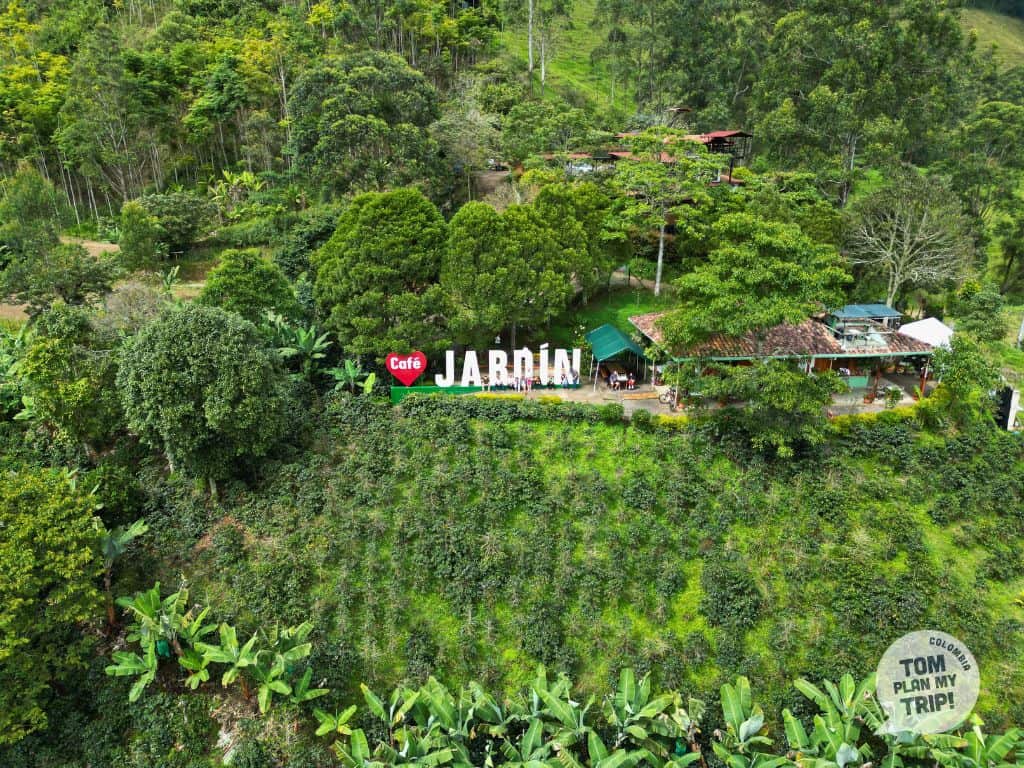
Located at an altitude of 1,750 m in the southwest of Antioquia, Jardín is at the junction of two ecosystems: the humid subtropical forests influenced by air masses from the Chocó on one side, and the Andean cloud forests on the other.
The municipality stretches over a remarkable altitude gradient, from the gorges carved by the Río San Juan to the misty ridges exceeding 3,000 m in altitude.
This vertical stratification creates an astonishing diversity of environments and explains the area’s exceptional ornithological richness.
Jardín is one of the most accessible birdwatching destinations in Colombia.
The Andean cock-of-the-rock is its claim to fame: you can observe it up close just outside the village in a private reserve.
Higher up, more than 400 species have been recorded along Ventanas Road heading towards Riosucio, including remarkable endemic species: the Yellow-eared Parrot, Chami antpitta, the chestnut-crested cotinga, and the red-hooded tanager.
The trek “de las 7 cascadas” is an opportunity to spot the russet-backed Oropendola (commonly called Oropendola) and see its characteristic nests, long fibrous pouches hanging in colonies at the tops of trees.
The Jardín de Rocas Natural Reserve, 400 meters from the main square of Jardín, is the most easily accessible site in the country for observing the Andean cock-of-the-rock. In the late afternoon, between 3:00 PM and 5:30 PM, you can witness the gathering of the males with scarlet plumage.
Managed by ProAves, the Loro Orejiamarillo Reserve is the ideal base for observing the yellow-eared parrot — a species the reserve has helped prevent from extinction.
Finally, Ventanas Road, lined with cloud forests, is among the key birdwatching corridors in Colombia. Its must-see stop: the Mirador El Roble, where the feeders of Doña Lucía — a local whose initiative to feed the antpittas has become a worldwide reference — allow you to observe these Colombian birds up close.
© Tomplanmytrip
THE DEPARTMENT OF CALDAS
From coffee fincas to the kingdom of the condor.
This department offers an incredible diversity of ecosystems.
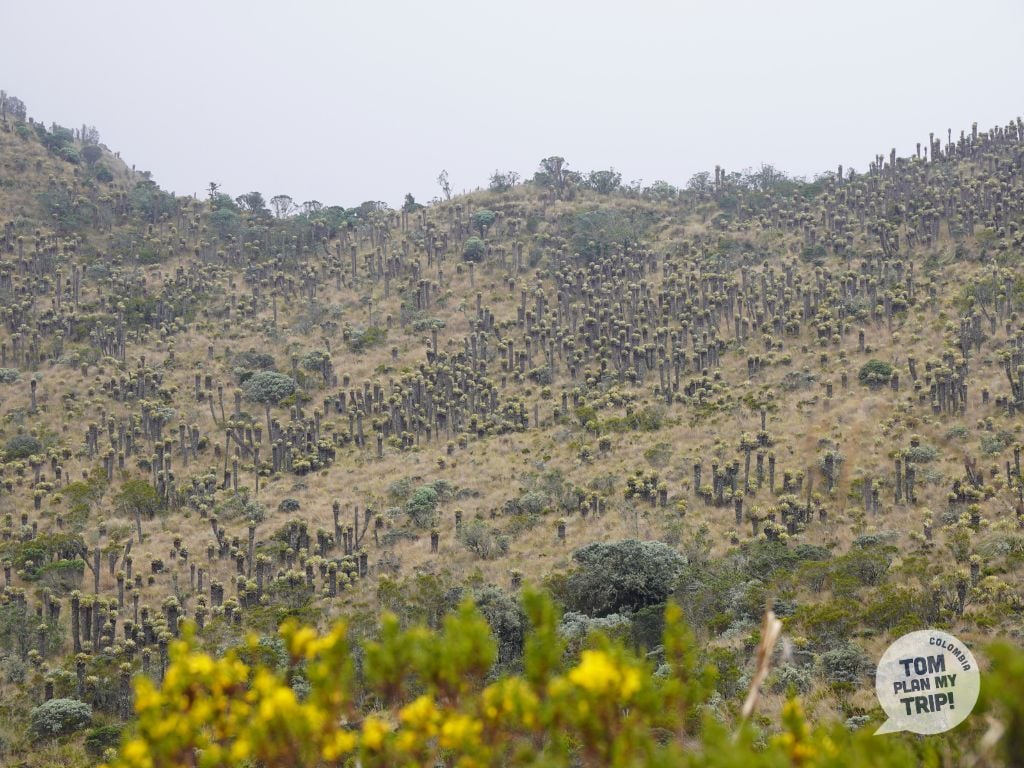
Over a few kilometers, stretch humid tropical forests, shaded coffee plantations, cloud forests clinging to the Andean slopes, wind-swept páramos, and finally the eternal snows of Nevado del Ruiz.
This altitudinal gradient — from 1,000 to over 5,000 meters — creates, at each transition, new ecological niches and new microclimates, fostering exceptional biodiversity.
The cloud forest, starting at 1,800 meters in altitude, is particularly remarkable: humid and dense, it is home to species found nowhere else in the world.
For bird watchers, this dizzying elevation change is a boon: in one day, you can change three times the birdlife by simply changing altitude.
With more than 800 bird species, including 22 endemic to Colombia, Caldas is one of the richest departments in ornithology.
Its avian richness follows the elevation change:
In the coffee-growing areas and low forests, you will encounter multicolored tanagers, hummingbirds, parrots, and orioles, easily observed around the feeders at the lodges.
As you ascend towards the cloud forest, the species become more discreet but more exclusive — black-billed mountain toucan, bicolored antpitta, white-capped tanager — a localized and highly sought-after species — and the multicolored tanager, endemic to Colombia and emblem of the department.
Higher up, in the páramos of the Los Nevados Park, buffy helmetcrest, a high-altitude hummingbird endemic to the central Colombian Andes, is among the most coveted species by birdwatchers worldwide.
And finally, the birdwatcher’s Holy Grail: the Andean condor, which can sometimes be spotted soaring above the snow-capped peaks of Los Nevados.
Caldas is home to some of the best birdwatching sites in Colombia.
At low altitude, Hacienda Venecia and Finca La Romelia combine a visit to a coffee farm with birdwatching around the feeders.
30 minutes from Manizales, in the low-altitude rainforest, Tinamú Birding Nature Reserve is one of the best birdwatching reserves in the country: 260 species on 12 hectares, feeders for hummingbirds and tanagers, and an expert guide on site for 20 years.
In the cloud forest, Owl’s Watch — nestled in the Río Blanco reserve and world-renowned for its antpitta feeding stations — and Hacienda El Bosque, allow for observing the black-billed toucan and the multicolored tanager in their natural habitat.
Finally, Hotel Termales del Ruiz, a high-altitude hotel about 50 kilometers from Manizales, is a great spot to observe the hummingbirds of the paramos.
© Tomplanmytrip
CALI & SAN CIPRIANO
At the crossroads of two avifaunas.
The Cali region offers a combination of rare ecosystems in a relatively small area.
To the east of the city, the western slopes of the Andes house a dense, humid cloud forest — that of the famous “Km 18“, one of the most renowned birdwatching routes in Colombia.
To the west, heading down towards the Pacific, you dive into the Chocó biogeographic region: one of the most important biodiversity hotspots on the planet, with a primary rainforest, extreme rainfall, and some of the highest bird endemism rates in the world — over 25%.
San Cipriano, at the gates of Buenaventura, is one of the most accessible entry points.
The Cali region is one of the few in the world where you can observe two totally distinct bird populations in a single day.
In the Andean cloud forest, in the ” Km 18 ” area, 18 km from Cali, the endemics of the Andean Chocó are concentrated: toucan barbet, velvet-purple coronet, violet-tailed sylph (hummingbird), and multicolored tanager, or even the rose-faced parrot (parrot) and the astonishing club-winged manakin, whose wings produce a unique mechanical sound in the world.
In San Cipriano, in the Pacific rainforest, you can observe the endemic species of the Pacific Chocó: the five-colored barbet, the toucan of Chocó, and the black-tipped cotinga.
The ” Km 18 ” area, located 18 km from Cali, on the mountain road crossing the Farallones National Park, is a world-renowned reference for birdwatchers.
Several birdwatching sites have been established there, two of which are well-known:
In the heart of the Anchicayá forest, the feeders installed in the garden of a local resident, Doña Dora, attract dozens of species in a very small area. You can notably observe the toucan barbet up close.
La Florida Birding, a little further up the road, is the reference for observing the multicolored tanager.
An hour from Cali, Araucana Lodge stands out as the best base for exploring the region: the feeders in the garden of this boutique lodge are very popular with birds, and guides can take you to both km 18 and San Cipriano.
© Tomplanmytrip
BOGOTÁ & SURROUNDINGS
Rare endemics at the gates of Bogotá.
Situated at an altitude of 2,600 meters in the Eastern Cordillera, Bogotá is surrounded by several ecosystems accessible within a few hours of driving: humid cloud forests, páramos with frailejones, Andean wetlands, and dry forests.
To the east, the Chingaza National Park is home to one of the best preserved páramos in Colombia, accessible in less than 2 hours from the capital.
To the south, Sumapaz is the largest páramo in the world: a vast territory of glacial lakes, frailejones, and peat bogs, less than two hours from Bogotá, still preserved from mass tourism.
A vertical diversity of ecosystems makes Bogotá an interesting base for birdwatchers, whether they are experienced or amateurs.
The surroundings of Bogotá feature three distinct avian registers according to altitude.
In the wetlands of the Bogotá savanna, two very localized, endemic species attract birdwatchers from around the world: the Bogotá rail and the Apolinar’s wren.
Higher up, in the cloud forest of Chicaque, the black inca (hummingbird) and the golden-bellied starfrontlet are popular subjects for nature photographers.
In the páramos of Chingaza and Sumapaz, finally, high-altitude hummingbirds dominate — the green-bearded helmetcrest, the blue-throated starfrontlet, the tyrian metaltail — and coexist with the rufous-fronted parakeet and the silvery-throated spinetail.
30 minutes from Bogotá, the Chicaque Natural Park opens onto the Andean cloud forest. Its trails pass through centuries-old oak groves and waterfalls, and its feeders attract a multitude of hummingbirds and tanagers.
The park offers on-site accommodation, with cabins perched in the canopy.
35 minutes from the capital, the La Calera Hummingbird Observatory is a private high mountain garden — at 3,000 meters altitude — where you can observe more than 14 species of hummingbirds, including the fascinating sword-billed hummingbird. Visits are by reservation.
For high-altitude endemics, Chingaza National Park is the favorite spot for birdwatchers — local guides organize tours at sunrise when the páramo hummingbirds are most active.

© Tomplanmytrip
THE META DEPARTMENT
At the crossroads of two worlds.
Meta, gateway to the Llanos, gives you the feeling of stepping into another world — just a few hours from Bogotá.
To the west, the foothills of the eastern Andes; to the east, endless savannas stretching to the Orinoco basin. Between the two, a mosaic of ecosystems: forests lining waterways, wetlands, morichales — stands of semi-aquatic palms essential to the region’s hydrological balance.
A unique crossroads between three biotopes — Andean, Amazonian, and Orinoquian — the department is home to more than 1,100 species of birds — second in the nation — and competes with the largest ornithological destinations in South America.
Meta illustrates perfectly the avian richness of the Llanos. At the edge of the Andean foothills, Amazonian and Andean species cross paths in an exceptional ornithological transition zone.
The wetlands attract flocks of waders: jabiru, scarlet ibis, roseate spoonbill, and cocoi heron.
In a very open savanna landscape, the morichales and riparian forests are refuges for forest species: hoatzin — an amazing bird with a prehistoric appearance and loud call —, brown jacamar, lance-tailed manakin, parrots, and herons concentrate there.
The savannah is the hunting ground of the burrowing owl and the horned screamer.
The Meta lives to the rhythm of water: in the rainy season, part of the territory disappears under water; in the dry season, wildlife concentrates around water points, which become great observation spots.
At the gates of Villavicencio, the Bosque Bavaria — eBird hotspot (the global reference platform in ornithology) with more than 400 species — and the Rancho Camaná reserve are the must-see sites in the department to observe these birds of Colombia.
Further south, in Granada, the Los Camorucos private reserve surprises with its diversity, especially in terms of hummingbird species.

© Tomplanmytrip
THE CHOCÓ DEPARTMENT
The preserved cradle of Pacific Colombia’s birds.
The Chocó is one of the most humid places on the planet.
Wedged between the Pacific Ocean and the western Andes, this department is home to some of the world’s most tropical rainforests, rich in biodiversity.
The isolation created by the Andes has led to an explosion of endemism: plants, butterflies, amphibians, and especially birds — about 25% of the species that live there are found nowhere else on Earth.
Mangroves, primary forests, and coastal areas – the environments interlock, and each habitat houses its own wildlife.
Not easily accessible, cut off from the world by the jungle and the absence of roads, the Chocó has remained untouched — a dream exploration ground for the ornithologist.
The Chocó has 650 bird species, including a concentration of strict endemics.
Among these endemic species, the Baudo oropendola, with its pendulous nests hanging from trees, has become the symbol of the region.
Other endemics: the Chocó toucan with its massive beak and the five-colored barbet — one of the most colorful birds on the continent — that inhabit the canopy. Just like the black-tipped cotinga, which requires patience and a trained eye to be spotted.
In the damp undergrowth, you can watch for the discreet Baudo guan and the white-throated quail-dove.
The harpy eagle remains the grail for any ornithologist who ventures into the untouched primary forests.
Bahía Solano is the gateway to the Chocó for birdwatching.
The road connecting the town to the village of El Valle allows, from dawn, the observation of remarkable landscapes at the edge of the forest.
In El Valle, El Almejal, a natural reserve on the Pacific coast, is home to endemic species and migratory birds within the same forest corridor.
Thirty minutes by boat, the Ensenada de Utría National Park features a remarkable birdlife along its forest trails and coastal mangroves, in a beautiful and unspoiled setting.

© Tomplanmytrip
THE DEPARTMENT OF CASANARE
The great theater of lowland Colombian birds.
Casanare belongs to the Llanos of the Orinoco River basin, which are vast plains common to Colombia and Venezuela.
This natural environment operates at the rhythm of two distinct seasons: a rainy season, which transforms the savannas into vast wetlands, and a dry season, which concentrates all the wildlife around the residual water points.
Gallery forests along the rivers, natural prairies, swamps, and lagoons follow one another on a flat territory that seems endless.
Extensive ranching practiced in the hatos — these immense savanna ranches where the herds graze freely over thousands of hectares — has preserved these large open spaces, creating a unique balance between human activity and the wild biodiversity that hardly exists elsewhere in Colombia.
No endemics in the Llanos of Casanare — but an avian abundance that leaves one speechless.
In the dry season, the residual lagoons attract extraordinary concentrations of water birds: jabiru, roseate spoonbill, scarlet ibis, and maguari stork mingle in dense colonies, offering scenes worthy of a wildlife documentary.
The Orinoco goose and the horned screamer populate the banks. In the gallery forests, the hoatzin lives in small, noisy colonies at the edge of natural channels.
The black skimmer skims the surface of rivers at dusk.
Nowhere else in Colombia is the birdlife as visible and accessible.
In Casanare, the hatos, converted into nature reserves, have become top spots for birdwatching.
The most famous is Hato La Aurora, a regional reference for birdwatching safari: floodable savannas, gallery forests, and water points concentrate birdlife of a rare density.
Three hours from Yopal, the El Encanto de Guanapalo reserve includes several hatos on thousands of hectares of preserved savanna: Mata de Palma, Altamira, and Montana.
Hato Berlín, on the edge of a lagoon, attracts large numbers of water birds. Hato Altagracia, finally, is the most isolated and the wildest — accessible only during the dry season.
Depending on the season, you will make your observations by jeep, on horseback, or by boat.

© Tomplanmytrip
THE DEPARTMENT OF NARIÑO
An unexplored avian paradise.
Department in the south of Colombia, bordering Ecuador, Nariño surprises with the diversity of its natural environments over a relatively modest area: tropical rainforest on the Pacific slope, Andean cloud forest, páramo, volcanic lakes, and coastal wetlands.
This overlapping of environments, amplified by exceptional rainfall on the western slope of the Andes, generates one of the highest rates of endemism in Colombia.
Long rendered inaccessible by armed conflict, Nariño is now open to nature tourism — and the birdwatchers who venture there already describe it as an exceptional environment.
What attracts birdwatchers to Nariño are the species found nowhere else.
Like the plate-billed mountain-toucan in the cloud forest, or in the lowland rainforest, the long-wattled umbrellabird, which fascinates with its appearance: shaggy crest, fleshy and feathered appendage hanging from the male’s neck, and a heavy flight.
The moss-backed tanager and the toucan barbet complete the list of species sought after by birdwatchers.
Nariño is also a paradise for hummingbirds: more than thirty species have been recorded there, including the violet-tailed sylph and the velvet-purple coronet.
The two main reserves of Nariño are located on the Pacific slope of the Andes, a few dozen kilometers apart.
La Planada, managed by the Awá indigenous community, protects a primary cloud forest of exceptional richness — this is where the Plate-billed Mountain Toucan lives.
At a lower altitude and accessible from the Pasto-Tumaco road, Rio Ñambí delves into the tropical rainforest: the long-wattled umbrellabird and the extraordinary density of hummingbirds make it a prime spot for birdwatching.
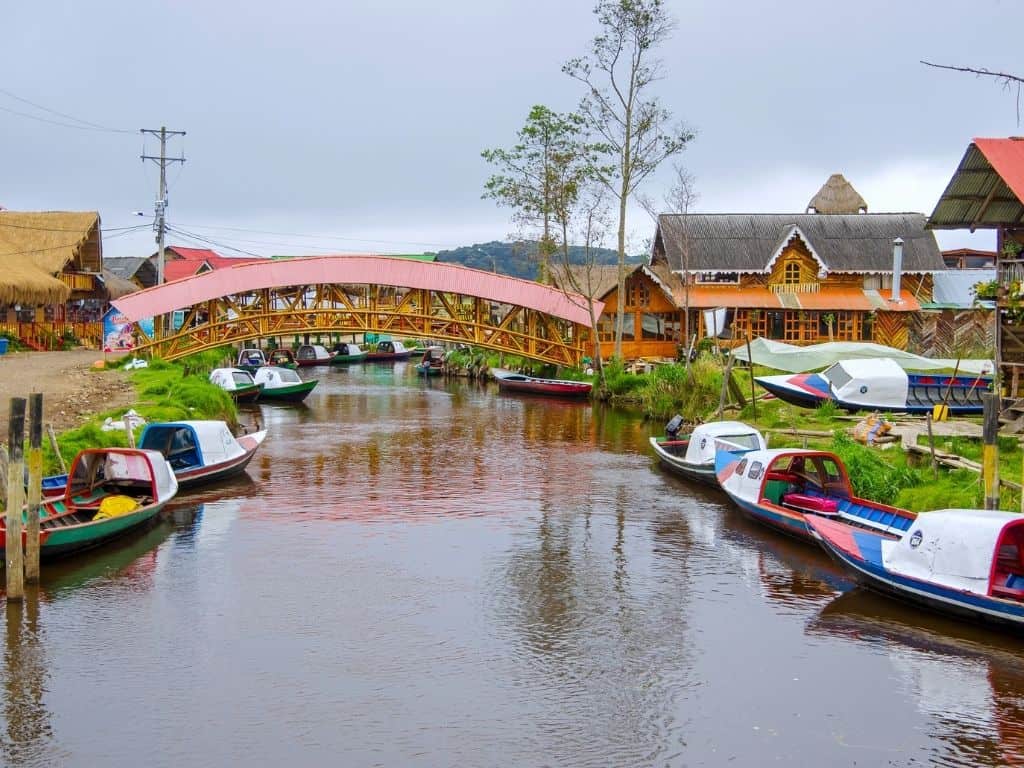
To the east, on the Andean side, the Laguna de La Cocha, a high-altitude lake surrounded by several natural reserves, is ideal for observing aquatic birds and páramo species.
© Tomplanmytrip
THE DEPARTMENT OF CAUCA
The domain of the condor.
Cauca occupies the heart of the Colombian Andes, where the three Andean mountain ranges converge.
This is where four major rivers of the country originate — Magdalena, Cauca, Patía, and Caquetá — a unique concentration that has earned this territory the status of a UNESCO biosphere reserve.
The Puracé Park is its beating heart: an active volcano whose geothermal activity sculpts a strange landscape — sulfur springs in yellow and orange hues, glacial lagoons, valleys of frailejones.
From the bare, wind-swept páramo to the dense cloud forest, down to the dry forest of Patía below, this altitudinal stratification makes Cauca a natural laboratory of exceptional richness.
The Cauca is above all the Andean condor — the emblem of Colombia, soaring over the páramos of Puracé.
In the cloud forests lives Isidore’s eagle, difficult to spot, just like the Cauca guan, an endemic galliform of the central Andes, in danger of extinction, with a total population not exceeding a few hundred individuals.
Two other species live only in one massif of the Cauca, the Munchique massif, and attract the interest of ornithologists from far away: the gorgeted puffleg (a hummingbird), discovered in 2005 and classified as critically endangered, and the Munchique wood-wren, a vulnerable species discovered only in 2003.
Finally, the noble snipe is a specialist species of the paramo that can be regularly observed.
Two national parks are a must-see for birdwatching in Colombia in the Cauca.
Puracé, first, the most iconic, an hour from Popayán: its páramo trails, covered with frailejones and dotted with sulfur springs, lead to viewpoints where the Andean condor is regularly observed in the early morning.
Munchique, then, on the Pacific slope of the western mountain range, 61 km from Popayán: this lesser-known national park is home to about 500 species of birds, including 37 hummingbirds, in a rainforest.

© Tomplanmytrip
THE AMAZON
Macaws and legendary birds: a prodigious avian richness.
The Colombian Amazon occupies the southeastern third of the country — an immensity of primary rainforest crossed by the Amazon and its tributaries, at the border with Peru and Brazil.
Here, life adapts to the river’s floods: during the rainy season, the forests are flooded for kilometers, creating unique aquatic habitats.
In the dry season, the banks and emerging islands become exceptional places of concentration for wildlife.
Dense canopy, flooded forests, ephemeral river islands, sandy shores — each environment hosts its own species. More than 750 bird species have been recorded in the Colombian Amazon alone, a true boon for birdwatchers.
The ornithological register of the Colombian Amazon is dominated by parrots, parakeets, and macaws, including the blue-and-yellow macaw, whose brilliant plumage is striking.
More than twenty species have been recorded in the region of Puerto Nariño alone — colorful, loud, impossible to miss.
The intriguing hoatzin lives in noisy colonies on the riverbanks. The agami heron, one of the most beautiful herons in the world, hides in the flooded forests.
Not to forget the hummingbirds, omnipresent in the canopy and forest edges, like the fork-tailed woodnymph whose male sports an iridescent green throat and a violet belly, with a distinctive tail.
Finally, discreet and difficult to observe, the harpy eagle, the largest and most powerful bird of prey in the South American rainforest, a formidable predator, remains the holy grail for any bird enthusiast.
Leticia, accessible only by plane or boat, is the gateway to the Colombian Amazon.
From there, an hour of navigation on the Amazon is enough to reach Puerto Nariño, a car-free village on the riverbank, which is an ideal base for bird watching.
Nearby, the Amacayacu National Park is the reference ornithological site of the region, with its primary forests, flooded forests, and banks — nearly 500 species have been recorded there.
Finally, for a wilder immersion in the Amazon jungle, the Marasha Nature Reserve, accessible from Leticia, is a choice site for bird watching with the help of a local guide from the Tikuna indigenous community, with a particularly trained eye.

© Tomplanmytrip
BIRD WATCHING IN COLOMBIA: THE ESSENTIALS
Birdwatcher’s Guide in Colombia.
No country in the world has as many bird species as Colombia — more than 2,000, which is one-fifth of the global total.
About 80 are endemic, with just under thirty concentrated in the Sierra Nevada de Santa Marta alone.
About 160 migratory species complete this data, crossing the country or wintering there depending on the seasons.
This extraordinary wealth is simply explained: Colombia is the only country in South America bordered by two oceans, crossed by three distinct Andean mountain ranges, and connected to both the Amazon, the Llanos and the biogeographic corridor of the Chocó — one of the richest and most isolated rainforests in the world, wedged between the Pacific and the Andes, where millennia of evolution in isolation have resulted in an exceptional rate of endemism.
So many ecosystems that have fostered an explosion of avian diversity and figures that make birdwatchers, both amateur and seasoned, dream.
Two events mark the ornithological year in Colombia.
The Global Big Day, organized each year in May by the Cornell Lab of Ornithology — a global institution dedicated to the study and conservation of birds, Cornell University, USA — is the worldwide reference ornithological event.
In one day, thousands of observers around the world identify species and submit their data on eBird, the most widely used collaborative platform in the world for recording and sharing bird observations, initiated by the Cornell Lab of Ornithology.
Since 2017, Colombia has consistently finished first. In 2024, more than 1,550 species were recorded in one day.
The other major event to discover the birds of Colombia is the Feria Internacional de Aves de Colombia, held annually in Cali, the “city of birds,” a crossroads of three major biogeographic regions: the Chocó, the Andes, and the Cauca Valley.
Conferences, guided outings, exhibitions: it’s the must-attend event for ornithologists, both amateur and professional.
Get up early — the birds in Colombia are active at sunrise — around 6 AM, all year round.
Equip yourself well — a good pair of binoculars is essential. Download the eBird app to identify species, check recent sightings, and if you wish, share your own observations.
Take a local guide — it’s the difference between hearing birds and seeing them. Colombian guides are among the best in the world — they recognize species by ear in a dense forest.
Stay quiet and patient — no noise, no sudden movements, speak little and in a low voice. Colombia’s rarest bird species reward patience.
Wear discreet colors — khaki, green, gray — and neutral colors blend you into the surroundings. Avoid white and red.
In Colombia, birdwatching is practiced all year round; it’s one of the great advantages of an equatorial country.
The rainy season can, however, complicate outings: muddy trails, reduced visibility — even though in the Andes, showers often fall in the late afternoon, leaving the mornings clear.
In general, the major Andean dry seasons offer the best conditions from December to February and from June to August.
In fact, each region has its own calendar: the Chocó is wet all year round; in Los Llanos of Casanare, the dry season offers ideal conditions for a birdwatching safari (December-March); in the Amazon, which follows the water cycle of the Amazon River, the low-water season (August-October) is more favorable for wildlife observation.
You’re not a birdwatcher, but the idea of encountering a macaw, a toucan, or even a condor in its natural habitat leaves you dreaming? Nature, adventure, culture: at Tomplanmytrip, we combine these ingredients according to your desires. Tell us about your project; we will organize your itinerary.

© Tomplanmytrip
Breathe, and let us take care of this beautiful adventure
Colombia is twice the size of France, with a diversity of landscapes that’ll make your head spin — and a real logistical puzzle, with roads winding through the Andes mountains.
What kind of adventure do you want to live? Is it really right for what you’re looking for? Is it safe? Is it too touristy?
Guessing and hoping you made the right call — sometimes that works. But not always.
And I won’t even get into the stressful surprises that force you to make some changes mid-trip.
Look, we’ve been doing this for years — and if you check our reviews, you’ll see we know what we’re doing. In less than an hour on a call, we figure out your ideal destinations together. We handle the rest.

© Tomplanmytrip
The Birds of Colombia
Majestic raptors, iridescent hummingbirds, extravagant toucans, multicolored tanagers — impossible to present them all as they are so numerous.
Here is a selection of the most iconic birds of Colombia that you might encounter during your explorations — their distinctive features, their habitat, and some anecdotes to recognize and watch them, without being a seasoned ornithologist.
TOM’S ADVICE
Want to discover Colombia? Our inspiration page reveals the essentials — landscapes, culture, and adventures. Feel free to reach out to us to organize your Colombian adventure!
And if you are a nature lover, our articles on natural regions, animals of Colombia, and wildlife watching in Colombia will help you grasp the full richness of this country.

Colombia’s Iconic Birds: A Selection of the Most Representative
Some birds of Colombia that might just surprise you along the way.
THE RAPTORS
Colombia is home to some of the most impressive raptors in the world — from the king of the Andean heights to the most formidable predator of the canopy.
The Andean Condor – Vultur gryphus

An exceptional glider, with absolute mastery of thermal currents.
What does it look like?
With a wingspan that can reach 3.3 meters, the Andean condor is the largest bird of prey and one of the largest flying birds in the world. Its longevity is remarkable (over 50 years).
In adulthood, its black plumage is enhanced by a collar of white feathers and broad light bands under the wings. The head, bare and bright red, and a hooked beak complete an immediately recognizable silhouette.
The male is distinguished by a crest and skin folds around the neck. The female is smaller; juveniles are gray-brown.
Where does it live in Colombia?
Fewer than 150 individuals remain in Colombia — a rare and very localized presence.
The condor thrives in large open spaces at high altitudes (above 3,000 meters): páramos, volcanic cliffs, snow-covered massifs, where the thermal currents are strong.
It is occasionally found in the Colombian Andes — notably in Puracé, Los Nevados and El Cocuy —, as well as, more rarely, in the Sierra Nevada de Santa Marta.
What sets it apart
National symbol and central figure of Andean mythology, the Andean condor plays an essential role as a “cleaner” in the balance of its ecosystem by feeding on large carcasses.
He can go several days without eating after a meal, cover hundreds of kilometers per day by gliding, and take long sun baths, his wings spread.
Monogamous and faithful for life, he courts his female with elaborate dances and nests on inaccessible ledges. The young stay with their parents for nearly two years.
The Harpy Eagle – Harpia harpyja
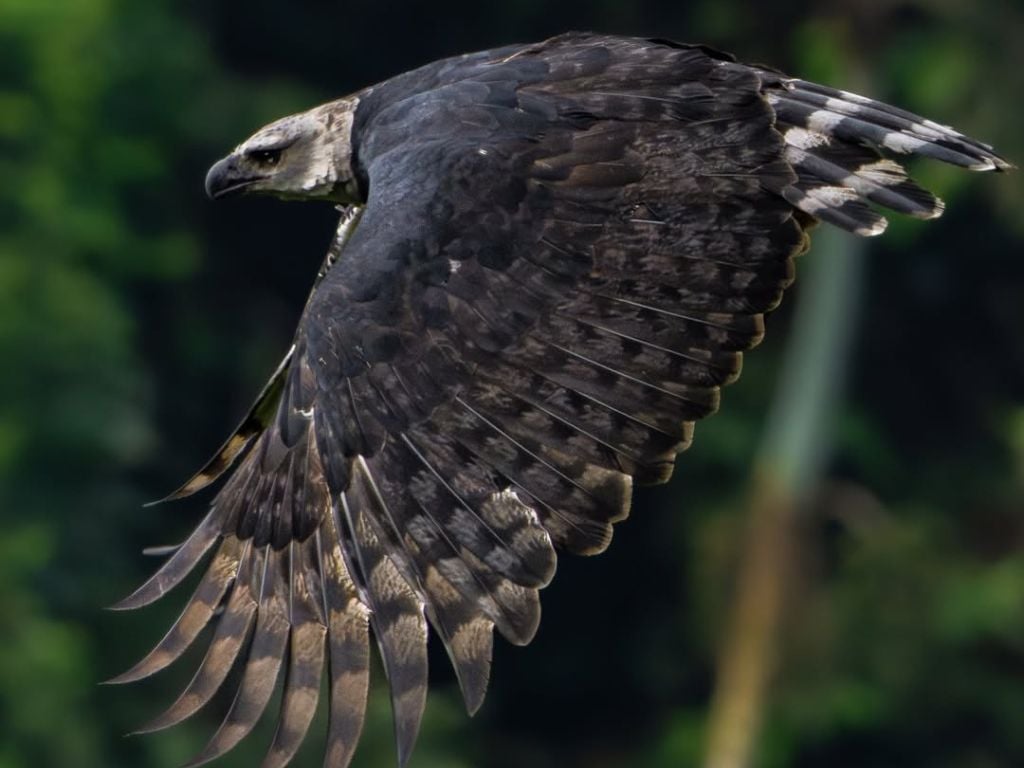
The most powerful eagle in the world.
What does it look like?
The harpy eagle is a massive eagle with a dark gray back and wings, a white belly, and a wide black band across the chest. The female is noticeably larger than the male.
Its gray head is topped with a double crest of feathers that it displays when alert, giving it an intimidating appearance.
Its piercing yellow gaze, hooked beak, and oversized talons, with terrifying gripping strength, leave no doubt about its formidable predator qualities.
Where does it live in Colombia?
This bird from Colombia nests and hunts in the large, dense, and remote lowland tropical forests away from any human presence.
In Colombia, it is mainly found in the Amazon, in the Chocó, and in certain areas of the Llanos.
The destruction of its habitat is gradually pushing it towards the most remote areas. Observing a harpy in the wild remains a rare experience, even for a seasoned ornithologist.
What sets it apart
The harpy eagle gets its name from the Harpies of Greek mythology — those half-woman, half-bird creatures with formidable talons. A name that suits it perfectly.
It hunts silently, perched for hours in the canopy, before swooping down on monkeys and sloths at over 80 km/h — its short, broad wings allowing it to weave between trees with prodigious agility.
Monogamous and faithful, the pair reuse the same nest for years, often over 30 meters in height.
Its presence is a reliable indicator of health: where harpies live, the forest is intact.
The Black Vulture – Coragyps atratus
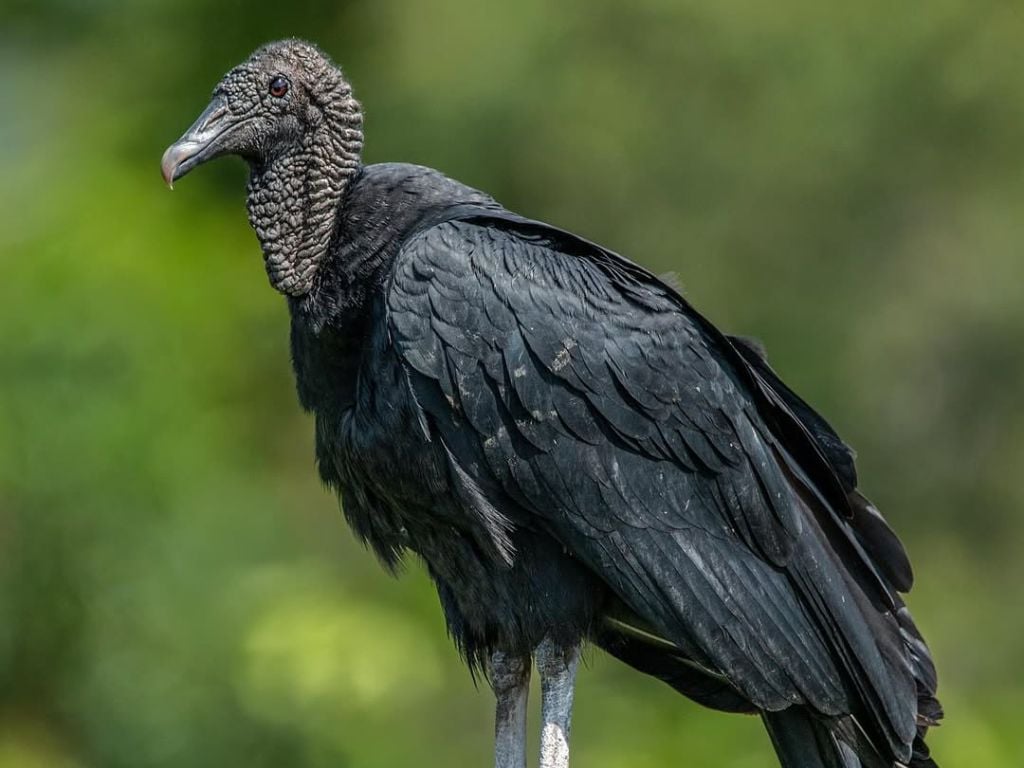
An unloved, rather unsightly, and yet very useful creature.
What does it look like?
The Black Vulture measures 60 to 70 cm and has a wingspan of about 1.50 m.
The plumage is entirely black, with slightly iridescent reflections. Its small bald head and bare neck reveal dark gray, wrinkled skin. The beak is short and hooked.
In flight, its broad, rounded wings end in well-defined “fingers,” with silvery patches visible under the tips. The tail is short and square.
Males and females are identical.
Where does it live in Colombia?
This bird of Colombia is found everywhere across the Colombian territory, from the coasts to the Andean regions, up to 2,500 meters in altitude.
A bird of open spaces, it frequents the sides of roads where it feeds on animals killed accidentally, landfills, cities, and countryside—anywhere it can find something to eat.
Very social, it moves and feeds in groups, sometimes alongside other vulture species, and sleeps in large collective roosts.
What sets it apart
Its flight is reminiscent of a bat: energetic and jerky flapping, followed by short glides.
The baldness is a hygienic adaptation — without feathers, bacteria do not cling during meals. This true cleaner of nature secretes gastric juices among the most acidic in the animal kingdom that neutralize the most dangerous pathogens.
Not at all fearful, you will encounter it moving on the ground, in groups, searching for food.
Colombians call it gallinazo.
PARROTS AND PARAKEETS
In Colombia, more than 55 species of parrots and parakeets inhabit the cloud forests and Amazonian canopies — and some live nowhere else in the world.
The Yellow-eared Parrot – Ognorhynchus icterotis
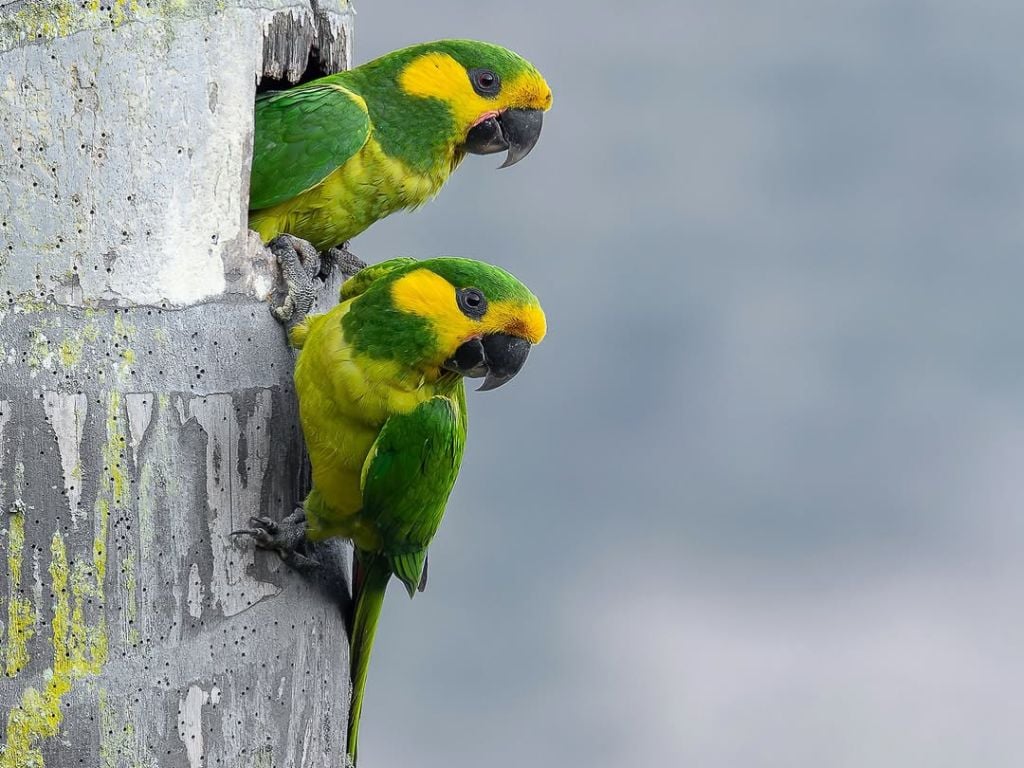
A conservation miracle.
What does it look like?
A large parrot of 42 cm, the golden-cheeked parakeet is immediately recognizable by its bright yellow cheeks, forehead, and belly, which contrast with an intense green plumage. Its black beak is powerful and hooked.
In flight, one can discern red highlights in the tail, often invisible at rest. Both sexes are identical.
Once distributed up to the northwest of Ecuador, it has only been observed in Colombian territory since the 1990s. The IUCN classifies it as vulnerable.
Where does it live in Colombia?
This bird of Colombia lives in the cloud forests of the Colombian Andes, between 1,800 and 3,000 meters in altitude.
It is now concentrated in the central cordillera, mainly in the departments of Tolima, Antioquia, and Caldas.
Its survival depends on a single tree: the wax palm. It feeds on it, nests in it, and follows its fruiting cycles, which rhythm its movements in nomadic groups.
It is in the Cocora Valley, near Salento, in the heart of the most well-known wax palm forest in Colombia, that it is now most easily observable.
What sets it apart
When researchers rediscovered it in 1999, there were only 81 individuals; the species was then considered extinct.
Its decline had an unexpected cause: every year, thousands of wax palms were cut down for the processions of Palm Sunday. In 2003, the Colombian Catholic Church banned this two-century-old practice — and the populations recovered. In 2019, there were 2,600 individuals.
It flies in small noisy groups, recognizable by their guttural calls that echo far into the forest.
A rare fact among parrots: a third adult sometimes helps the couple raise the chicks.
The Scarlet Macaw – Ara macao

A chatterbox with rainbow colors.
What does it look like?
This large parrot of 84 cm is recognizable by its intense scarlet red plumage.
The red runs down the top of its wings, which gradually turn from bright yellow to deep blue, forming a striking gradient. The face is white and bare, the beak massive, ivory on top and black underneath.
Its long, pointed tail, red and blue, represents half of its size.
Males and females are identical — only the young are distinguished by their dark eyes — yellowish in adults.
Where does it live in Colombia?
The Ara macao frequents the lowland tropical rainforests, up to 500 meters in altitude.
It is present in the Amazon and in the gallery forests of the Llanos.
It lives almost exclusively in the canopy, where it finds most of its food: fruits, nuts, seeds, and buds. Its powerful beak allows it to crack the hardest shells.
This Colombian bird nests in natural cavities of large trees, at a height of 7 to 25 meters above the ground.
What sets it apart
The scarlet macaw lives in a monogamous pair for its entire life. Outside of breeding, it lives in groups that can reach up to twenty individuals, flying and feeding together.
In the evening, the group joins a common roost in the large trees.
You may have the chance to witness the unforgettable spectacle of dozens of macaws gathered on the clay banks to ingest essential minerals and neutralize the toxins from the seeds they consume.
With a lifespan that can exceed 50 years in the wild, the scarlet macaw is one of the most long-lived birds in the Amazon.
THE HUMMINGBIRDS
With 160 species, Colombia is the country of the hummingbird — a tiny hyperactive creature.
The Sword-billed Hummingbird – Ensifera ensifera
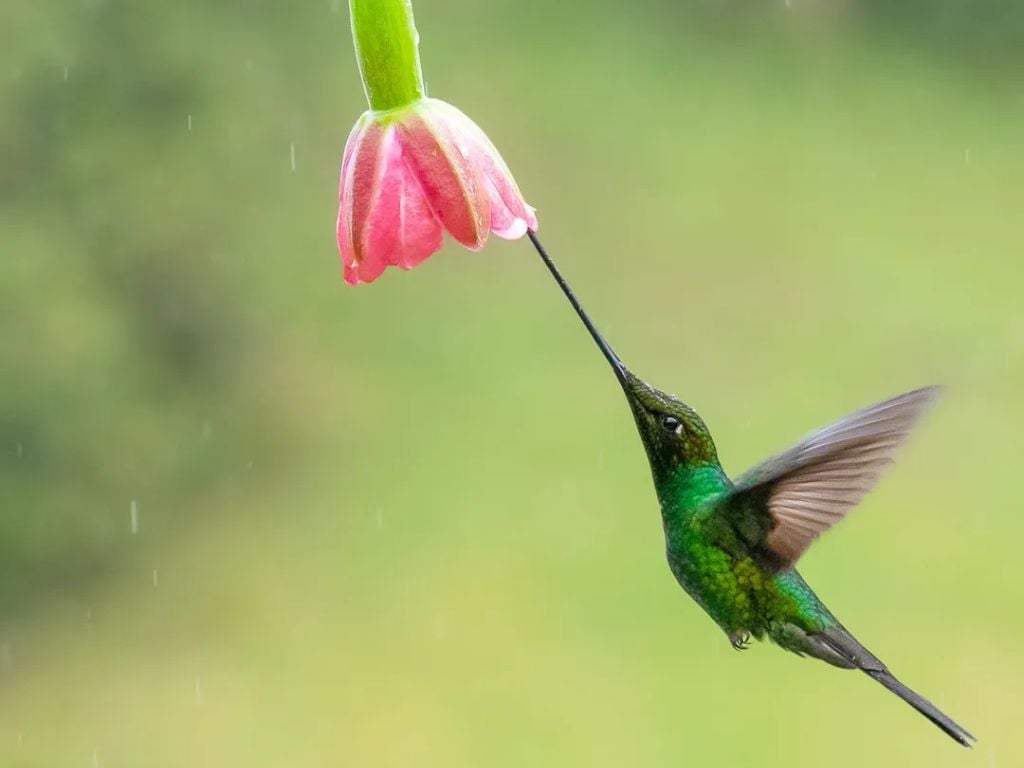
An oversized beak for such a small bird.
What does it look like?
The body of this amazing hummingbird measures only 13 to 14 cm — but its beak, slightly curved upwards, measures 10 to 12 cm by itself.
The plumage is metallic green, with bronze reflections on the head and back. The male has a dark throat with iridescent reflections and a slightly forked tail.
The female is identical, but her belly is white, speckled with green.
Where does it live in Colombia?
The Sword-billed Hummingbird is a bird of the heights.
In Colombia, it lives in the cloud forests of the three Andean mountain ranges, between 2,500 and 3,500 meters in altitude. Its habitat is directly dictated by its diet: it follows the distribution of flowers with long corollas — passionflowers, fuchsias — from which it is the only one to extract the nectar thanks to its long beak.
He also readily frequents the feeders installed in high-altitude gardens, which greatly facilitates his observation.
What sets it apart
Its beak is so long that it can’t use it to smooth its feathers: it grooms itself with its feet — a very rare behavior in a hummingbird.
When it is perched on a branch, this tiny bird from Colombia always points its beak towards the sky to maintain its balance.
Its relationship with the passionflower Passiflora mixta is a wonderful example of evolution. The bird and the flower have evolved together; the flower’s tube matches the exact length of its beak. Without the sword-billed hummingbird, this passionflower cannot reproduce.
TOUCANS
Nowhere else in the world will you find as many toucans as in Colombia: 21 species, from the Amazonian plains to the cloud forests of the Andes.
The Keel-billed Toucan – Ramphastos sulfuratus

Another beak story for the most extravagant bird of the tropical forest.
What does it look like?
The keel-billed toucan measures between 42 and 55 cm. Its black plumage contrasts with a bright yellow throat, a red under-tail, and blue legs.
But it’s its beak that is the most astonishing: a true explosion of colors — green, orange, red, blue — it can measure up to 15 cm, which is a third of its body.
Another amazing fact: made of keratin on a frame of thin bones, this beak is hollow and light as a feather, despite its massive appearance.
The eye is surrounded by bare turquoise skin. Males and females are identical.
Where does it live in Colombia?
A low-altitude bird of Colombia, the keel-billed toucan frequents the humid tropical forests up to 1,900 m in altitude.
In Colombia, it mainly occupies the Caribbean region and the Chocó of the Pacific.
It spends most of its life in the canopy, where it finds the fruits it feeds on.
To nest, it occupies tree cavities—natural or carved by woodpeckers—that the couple defends fiercely.
What sets it apart
In flight, beak pointed forward, black body and yellow throat: it resembles a flying banana.
Highly vascularized, its beak is also a thermal organ that regulates its body temperature in the humidity of the rainforest.
Large fruit-eater but opportunistic, it plays an essential role in seed dispersal, thus contributing to the regeneration of the forest.
Playful and sociable bird, it lives in groups of 6 to 12, engages in duels with its beak, and throws fruits at its peers.
When it sings, it emits a deep and repeated croak, reminiscent of frogs and audible from afar.
THE TANAGERS
Colombia is home to nearly 180 species of tanagers — some of the most colorful and easiest birds to observe in the country.
The Blue-gray Tanager –Thraupis episcopus
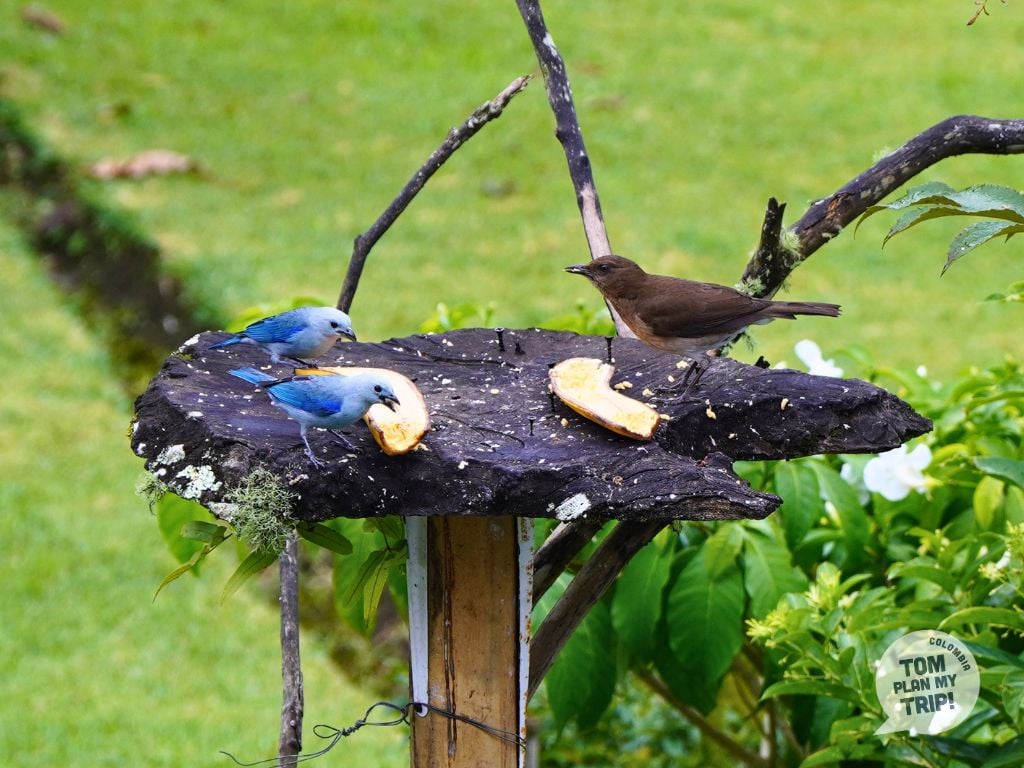
The bird of cities, villages, and gardens.
What does it look like?
A bird of 16 to 18 cm, the Blue-gray Tanager is entirely blue — but in subtle shades.
The head and belly are pale blue-gray, the back and wings are a darker blue, and the shoulders display a patch of a different shade depending on the subspecies — lavender, bright blue, or white.
Its beak is short and thick. Males and females are identical; the young are duller.
It’s nothing spectacular, but once you have identified it, you will see it everywhere.
Where does it live in Colombia?
It is found throughout the territory, up to 2,600 meters in altitude.
Not demanding, this bird from Colombia avoids dense forests but adapts to almost all semi-open environments: gardens, forest edges, plantations, roadsides, urban parks, where it easily finds fruits and nectar. It willingly feeds on cultivated fruits like papaya.
It generally lives in pairs or small groups.
What sets it apart
Its name comes from the Latin episcopus — bishop — in reference to its bluish hues reminiscent of episcopal garments.
Monogamous, it nests high in trees, but settles without issue in the crevices of human constructions. Both parents raise the chicks together.
Its nest is sometimes parasitized by the shiny cowbird, a bird that lays its eggs in the nests of other species so that they raise its young in its place.
WETLAND BIRDS
From the Llanos to the Caribbean coasts, Colombian wetlands are the realm of large waders and aquatic birds.
The Scarlet Ibis – Eudocimus ruber
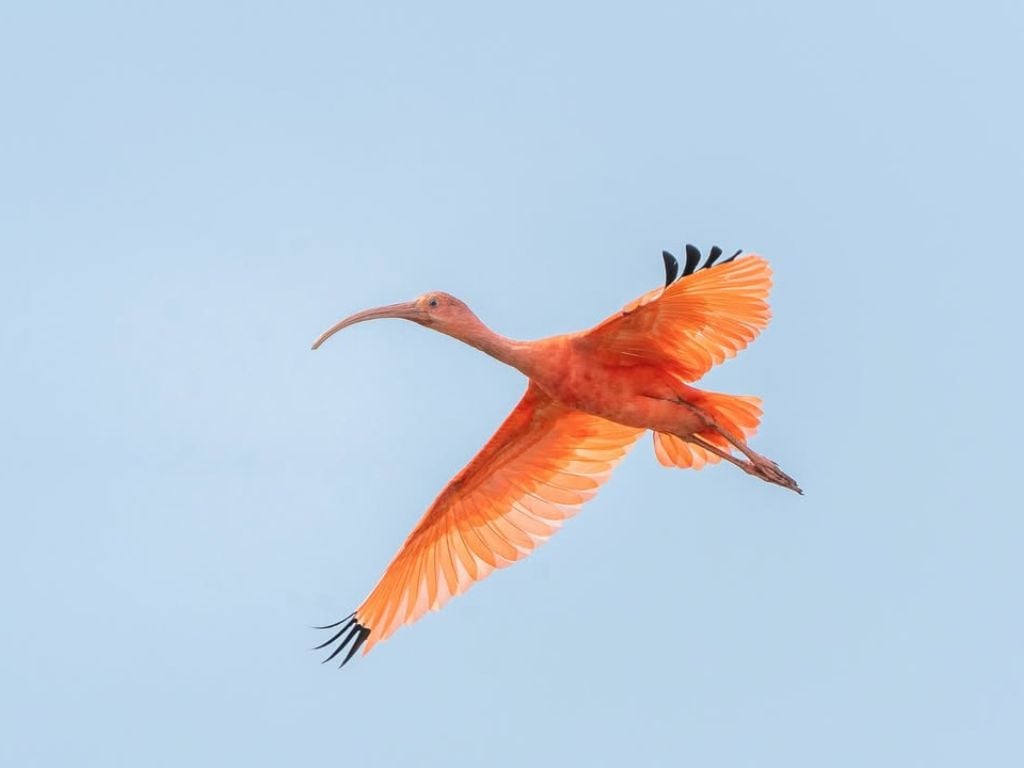
An elegant bird dressed all in red, from legs to beak.
What does it look like?
The scarlet ibis measures between 56 and 63 cm. Its plumage is entirely scarlet — except for the black tips of its primary wings, visible only in flight.
Its long, thin, downward-curved beak is used to probe the mud. Long legs and a long neck make it a well-proportioned wader.
Males and females are identical. The young are gray-brown at birth and only become bright red starting from their second year, thanks to the pigments from the crustaceans they consume.
Where does it live in Colombia?
The scarlet ibis is a bird of wetlands.
In Colombia, it is mainly found in the mangroves of the Caribbean coast and in the large plains of the Llanos in the east of the country, where the concentrations are the highest.
It only frequents mudflats, estuaries, lagoons, and shallow waters — anywhere its beak allows it to uncover crustaceans, insects, and mollusks.
Social, this bird of Colombia always moves in groups, sometimes in impressive flights gathering several thousand individuals.
What sets it apart
Like the flamingo, the Scarlet Ibis owes its color to what it eats: the crustaceans in its diet are rich in a carotenoid pigment that gradually tints its feathers.
It is the only wading bird in the world with red plumage.
In flight, flocks adopt a V-formation — a magical sight, especially against a mangrove landscape at sunset.
OTHER REMARKABLE BIRDS OF COLOMBIA
Colorful, extravagant, or unexpected — a small selection of other birds of Colombia you might encounter.
The Andean Motmot – Momotus aequatorialis
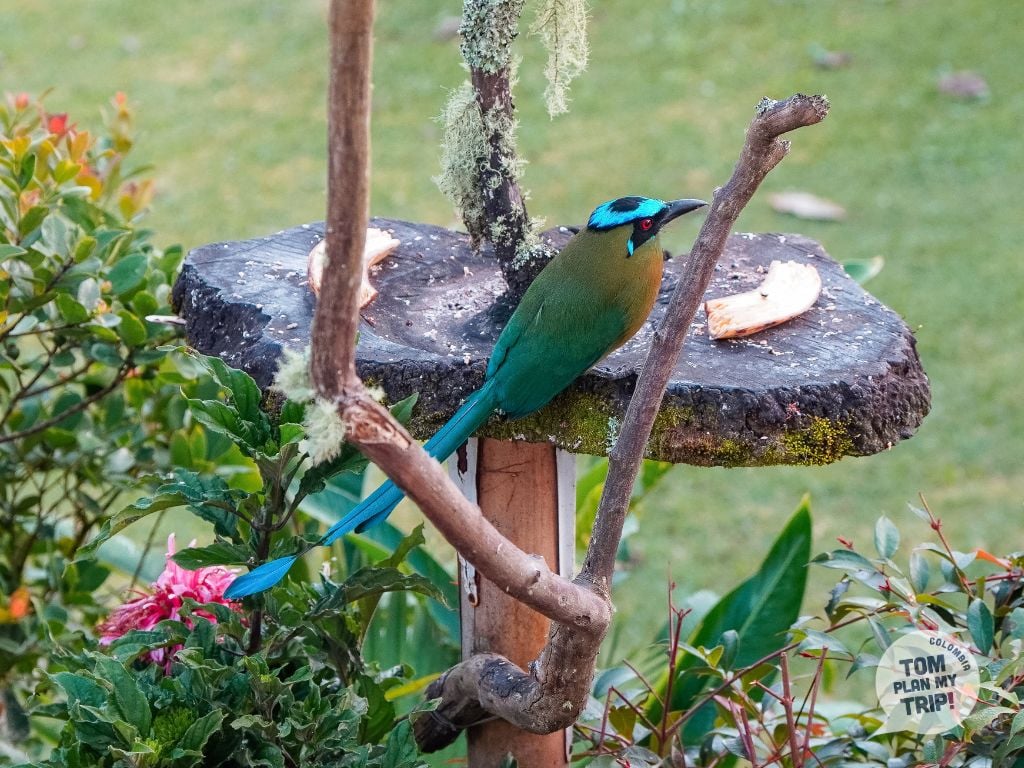
A curiosity of nature.
What does it look like?
The Andean Motmot measures between 46 and 48 cm. Its plumage is entirely green, with the wings and tail a bright blue.
It sports a crown of bright blue topped with a black cap in the center. A black mask borders its eyes.
Its most remarkable feature: an oversized tail with two central feathers ending in a racket shape — a plumage unmatched in the Andean forest.
Males and females are identical.
Where does it live in Colombia?
This large motmot lives in the humid high-altitude forests of the three Andean mountain ranges, between 1,500 and 3,100 meters in altitude. It favors dense undergrowth, often near streams.
Alone or in pairs, it can remain perched without moving, blending into the vegetation despite its bright colors — which sometimes makes it difficult to spot.
Omnivore, this bird from Colombia feeds on insects, small lizards, and fruits, and nests in very deep burrows that it digs along the banks of streams.
What sets it apart
Its tail has always intrigued: it was long believed that the bird pulled out its feathers. In reality, the fragile barbs fall naturally during preening, leaving a partially bare shaft with an end that forms the racket.
It uses its tail by swinging it from right to left to signal to predators that it has spotted them. A pendulum movement that, in Colombia, earns it the nickname of relojero — the clock bird.
It is at dawn that its song is heard: a deep and repeated “mot-mot,” reminiscent of an owl — which simply gave it its name.
In Colombia, it is commonly called barranquero andino.
The Golden-headed Quetzal – Pharomachrus auriceps
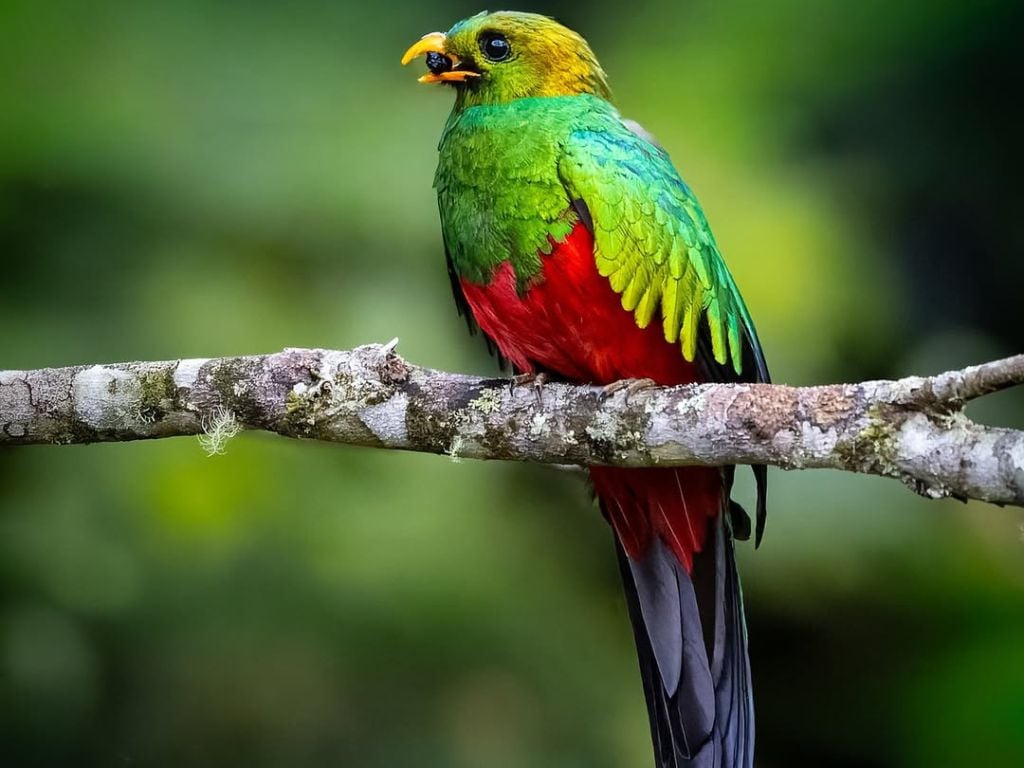
The discreet jewel of the cloud forests.
What does it look like?
The golden quetzal measures 33 to 36 cm, including the tail.
The male is magnificent: iridescent emerald green on top, with a bright red belly and chest. Its head has a golden-bronze sheen that earned it its name; its beak is yellow.
The female is more dull: golden-brown head, brownish-green chest, belly of a less bright red.
The tail of both sexes is entirely black.
Where does it live in Colombia?
The golden quetzal lives in the cloud forests of the Colombian Andes, between 1,200 and 3,100 meters in altitude.
This bird of Colombia is found on the three cordilleras and in the Sierra Nevada de Santa Marta.
An arboreal species, it spends most of its life in the undergrowth and the canopy, rarely on the ground. Mainly frugivorous, it swallows whole fruits, dispersing their seeds and thus playing a key role in forest regeneration.
It nests in the cavities of dead trees that it digs as a couple.
What sets it apart
Solitary outside the breeding season, the golden quetzal forms a monogamous pair from February to June. Both parents share the incubation and rearing of the chicks.
Its song is a melancholic and repetitive whistle that English ornithologists have described as “go-home, go-home.”
It is easier to hear than to observe: it can remain motionless for long minutes, its emerald green blending with the vegetation.
The Green Jay – Cyanocorax yncas
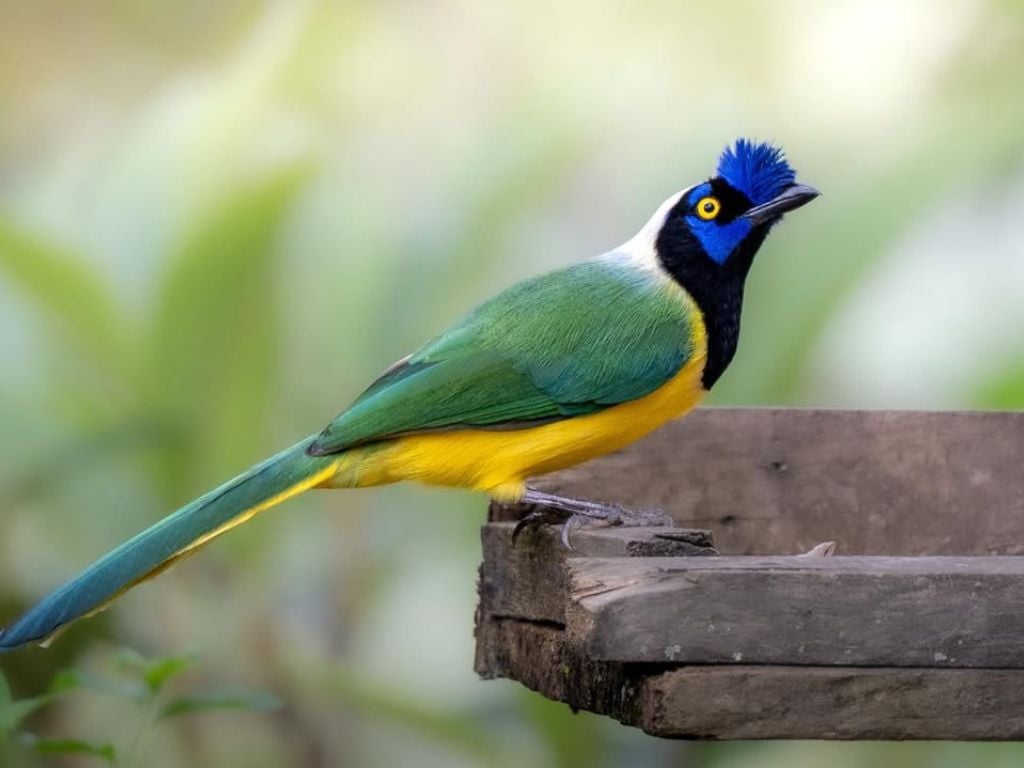
Clever, noisy, and colorful.
What does it look like?
The green jay measures 29 to 30 cm and sports a vibrant plumage. The back and wings are a deep green; the belly is bright yellow; the throat and facial mask are an intense black.
It features a white cap topped with a bright blue crest, and its eyes, with an iris of striking yellow contrasting with the black and blue, give it an astonishing look.
Both sexes are identical.
Where does it live in Colombia?
This Colombian bird lives in the Andean forests between 900 and 2,600 meters in altitude, across the three cordilleras.
It favors wooded edges, dense secondary forests with continuous canopy cover, and avoids open areas.
Gregarious by nature, it forms tight family groups that move together through the shrub layer and canopy, in search of insects, fruits, and eggs.
Noisy, it is easily noticeable by his repetitive calls that earn it the popular name Carriquí in Colombia.
What sets it apart
The green jay is a bird that arouses interest among ethologists.
Indeed, it is one of the rare birds to use tools: it has been observed grabbing twigs to dislodge insects under the bark of trees. It can also catch them in mid-flight.
It also practices cooperative breeding: the young from the previous season stay in the group to help feed the chicks born that year.
The Russet-backed Oropendola – Psarocolius angustifrons
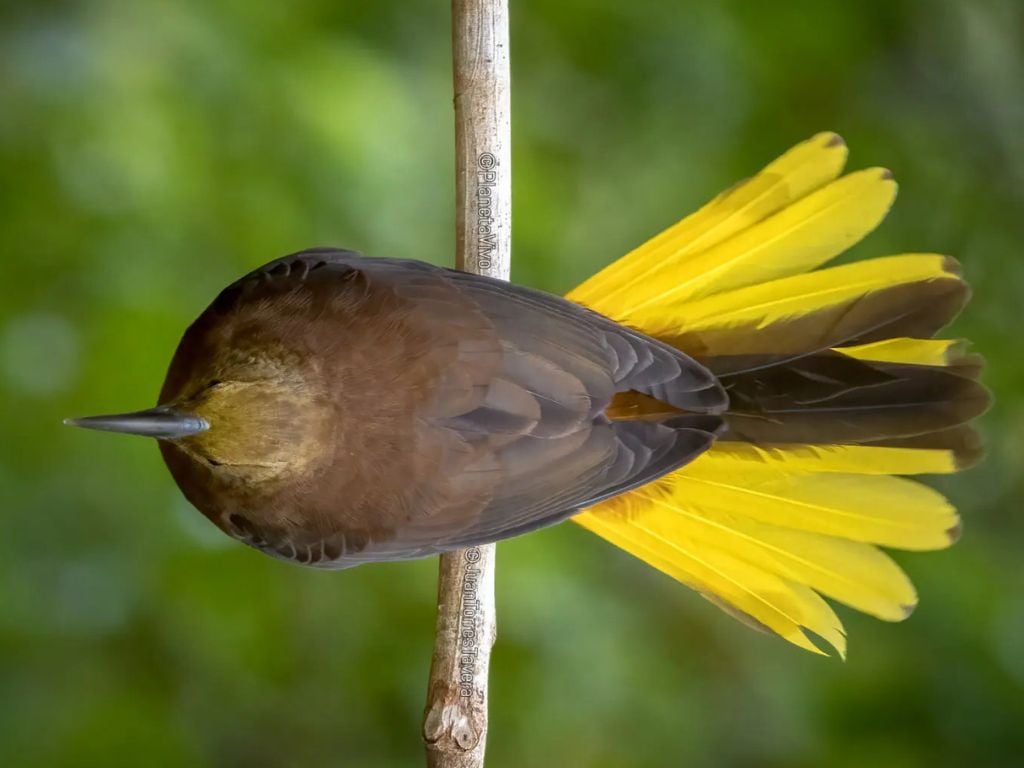
A rather noisy master architect.
What does it look like?
Large and stocky, this Colombian bird sports an olive-brown plumage, with a warmer russet back and rump. In flight, it reveals intensely yellow side feathers.
Its long, pointed beak varies according to altitude — yellowish in Andean subspecies, black in Amazonian populations.
Males and females wear the same livery, but the male is larger: 44 to 48 cm for the male, 34 to 38 cm for the female.
Where does it live in Colombia?
In Colombia, the rufous cacique is found on the slopes of the three Andean cordilleras and in the eastern Amazonian plains.
It frequents humid and very humid forests, wooded edges, and areas of secondary vegetation between 400 and 2,500 meters in altitude.
A gregarious bird, it moves in groups in the canopy, searching for fruits, insects, and nectar, sometimes in the company of other species.
What sets it apart
This Colombian bird owes its popular name, mochilero, to its nests made of plant fibers shaped like mochilas, those traditional Andean bags.
It hangs them in colonies at the end of isolated tree branches to keep them out of reach of predators.
Only the females build the nest, which can measure more than a meter, and incubate; the males, on the other hand, sing and compete for the colony’s hierarchy.
Oropéndola is its other nickname: oro for the yellow tail feathers, péndola for these pendulous nests that swing over the void.
The Andean Cock-of-the-rock – Rupicola peruvianus
A spectacular bird from Colombia and a master of seduction.
What does it look like?
With its scarlet plumage, the male is one of the most recognizable birds of the Andes.
Head, chest, and body are a vivid red-orange; the wings and tail are black and it has a large silver patch on its back.
Its disk-shaped, rounded, and prominent crest, which almost entirely hides its beak, gives it a rather curious profile.
The sturdy legs and eyes are a bright orange.
The female is much more discreet: dark reddish-brown over the entire body, reduced crest, pale and fixed eye. Male and female measure about 32 cm.
Where does it live in Colombia?
The Andean cock-of-the-rock lives in the cloud forests of the Andes, between 500 and 2,400 meters in altitude. It is easily observable in Jardín.
It is found on the humid slopes of the three mountain ranges, often near water courses, waterfalls, and rocky outcrops where it nests.
It loves dense, shaded forests, where it mainly feeds on fruits.
Outside the breeding season, it is a rather solitary and discreet bird, even shy, and becomes difficult to observe despite its bright plumage.
What sets it apart
The cock-of-the-rock is a master of the collective display.
The males gather on “leks” — natural display grounds, clearings, or open areas — and compete silently with plenty of jumps, bowing, inflated crests, and spread wings.
The female watches, chooses, then disappears. She will build her mud nest alone, attaching it to a damp rocky wall, often near a waterfall.
The Hoatzin – Opisthocomus hoazin
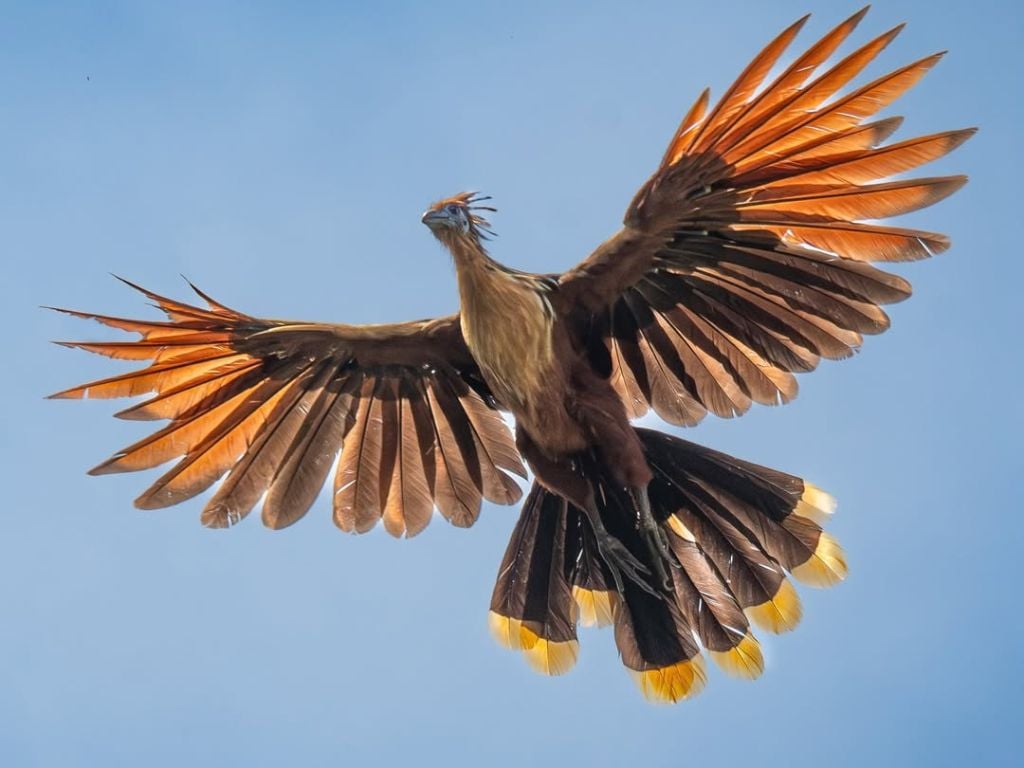
A bird from Colombia, seemingly straight out of prehistory.
What does it look like?
At 62 to 70 cm, the hoatzin has the silhouette of a large chicken lost in the jungle.
Its crest of reddish-orange feathers, standing on a head that seems too small for its stocky body, contrasts with its bare face of intense electric blue and bright red eyes.
The plumage on the back is dark brown, iridescent with bronze and olive, with white streaks on the nape. The belly is light beige, and the sides are reddish. The tail, long and square, ends with a white-beige band.
Males and females are almost identical.
Where does it live in Colombia?
The hoatzin is a bird of the tropical wetlands of the Llanos and the Amazon. It frequents the wooded banks of rivers, marshes, gallery forests, and mangroves. It never strays far from water.
Sedentary and clumsy in its movements, this funny bird of Colombia lives in small family groups and spends its days perched in the dense vegetation that overlooks the banks, making it rather easy to observe.
What sets it apart
The hoatzin flies very poorly due to its enormous crop, adapted for digesting leaves, which leaves little room for the pectoral muscles.
In fact, it is the only bird in the world to digest like a cow, through fermentation, which gives it its Colombian nickname of pava hedionda, the stinky turkey, because of the manure smell it emits.
On the other hand, its chicks are born with claws on their wings to climb and swim — which has long fascinated paleontologists regarding a link with the Archaeopteryx, the fossil ancestor of birds. These claws disappear in adulthood.
At sunset, its hoarse and guttural cries resonate in the marshes.
The Colombian Chachalaca – Ortalis columbiana
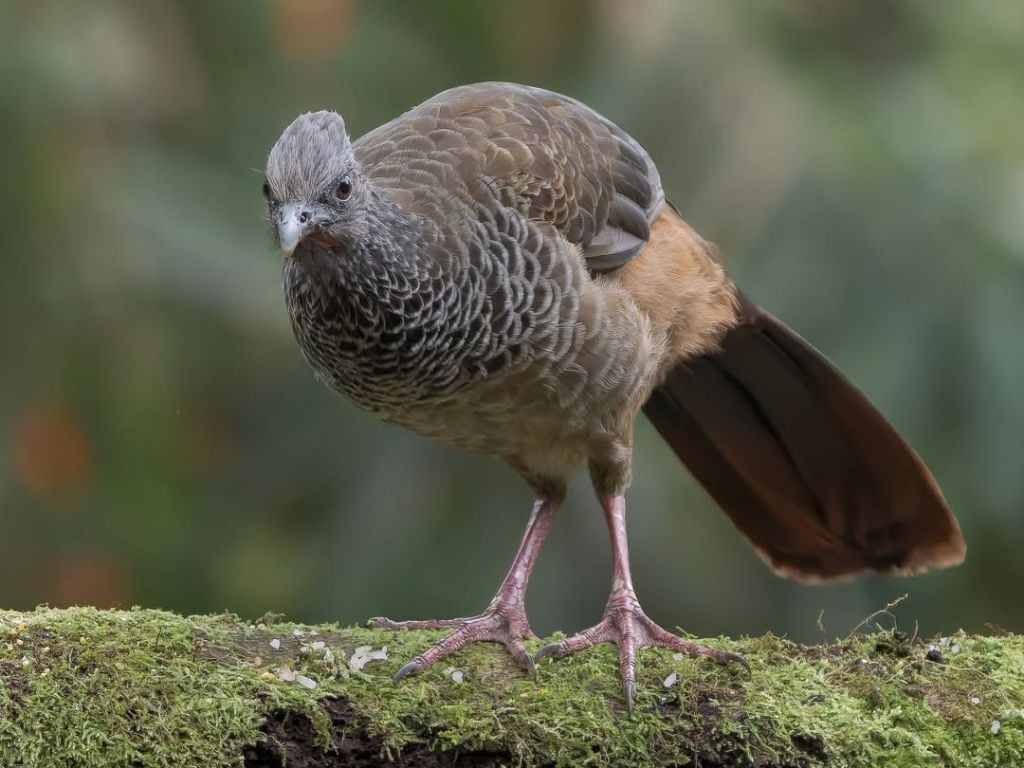
A most thunderous bird of Colombia.
What does it look like?
The Colombian Chachalaca has the silhouette of an arboreal galliform: sturdy body, long neck, small head, and long tail. It measures 50 to 60 cm.
Its plumage is simple — brown on the back, gray on the head, and a gray chest with well-marked white scales. The belly is beige, the flanks and the underside of the tail are reddish.
Under the throat, it has a small blood-red wattle, folded at rest, which unfolds when it sings at the top of the canopy. Males and females are identical.
Where does it live in Colombia?
Strictly endemic, the Colombian chachalaca lives only in the Colombian inter-Andean valleys: the Cauca Valley and the Magdalena Valley, between 300 and 2,200 meters in altitude.
It frequents humid forests, premontane forests, wooded edges, and areas of secondary vegetation.
Gregarious, it moves in small groups at different levels of vegetation, from the shrub layer to the canopy. It is also found in shaded coffee plantations and increasingly in peri-urban areas, such as in Barichara, in Santander, where it is impossible to miss.
What sets it apart
Its Colombian name, guacharaca, is a direct onomatopoeia of its call — a dry, hoarse, and repetitive call that several individuals emit in chorus, especially at sunrise. The groups respond to each other from one grove to another over long distances.
Threatened by the deforestation of the inter-Andean valleys, it shows an adaptability that now drives it to settle in parks and wooded gardens.
It plays a key role in the regeneration of inter-Andean forests — studies have shown that the seeds it ingests germinate significantly better after having passed through its digestive tract.
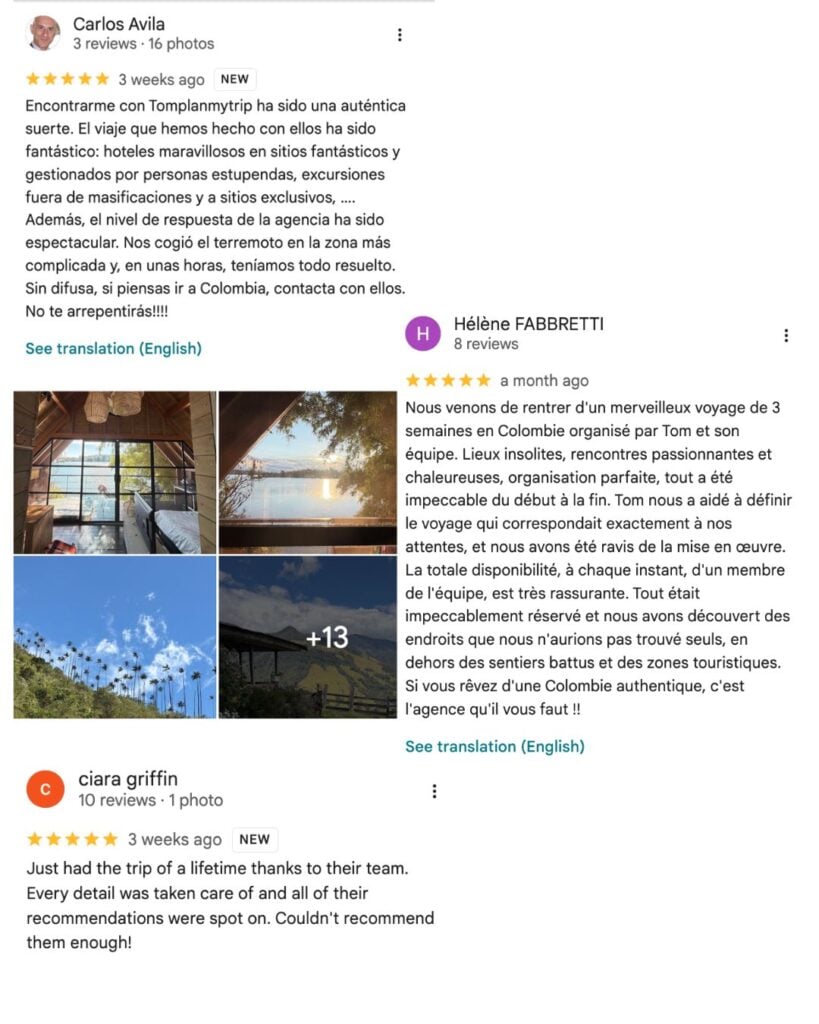
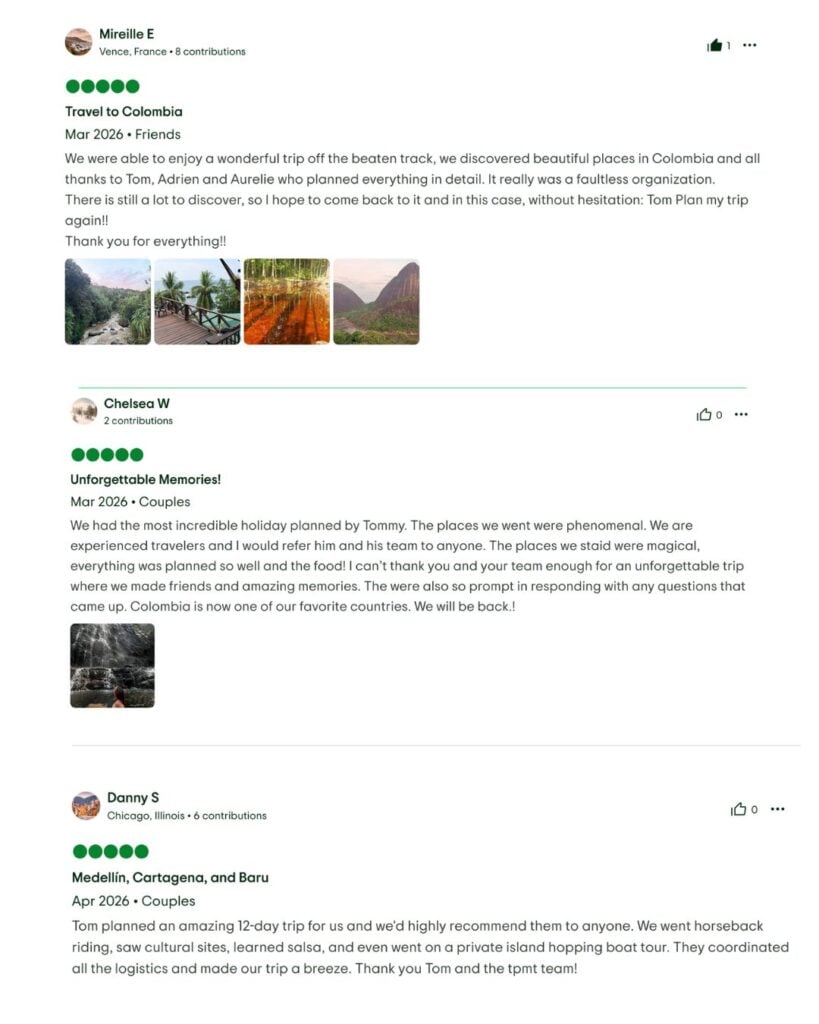
+185 five-star reviews on Google Maps

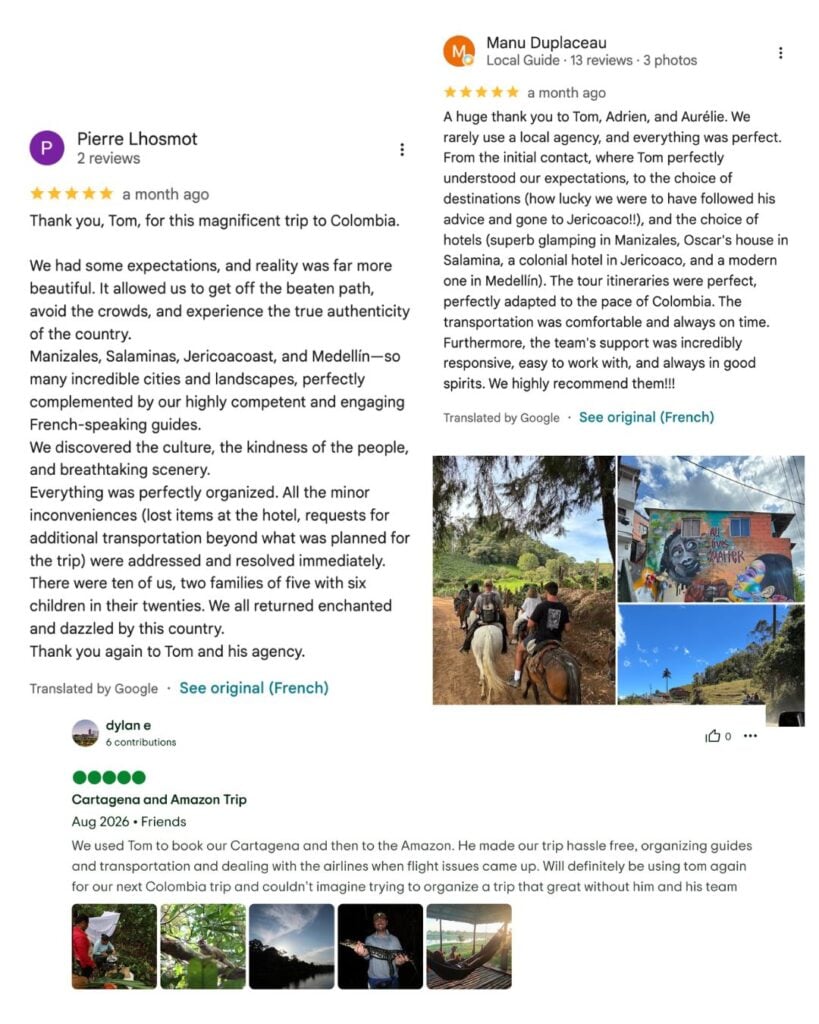
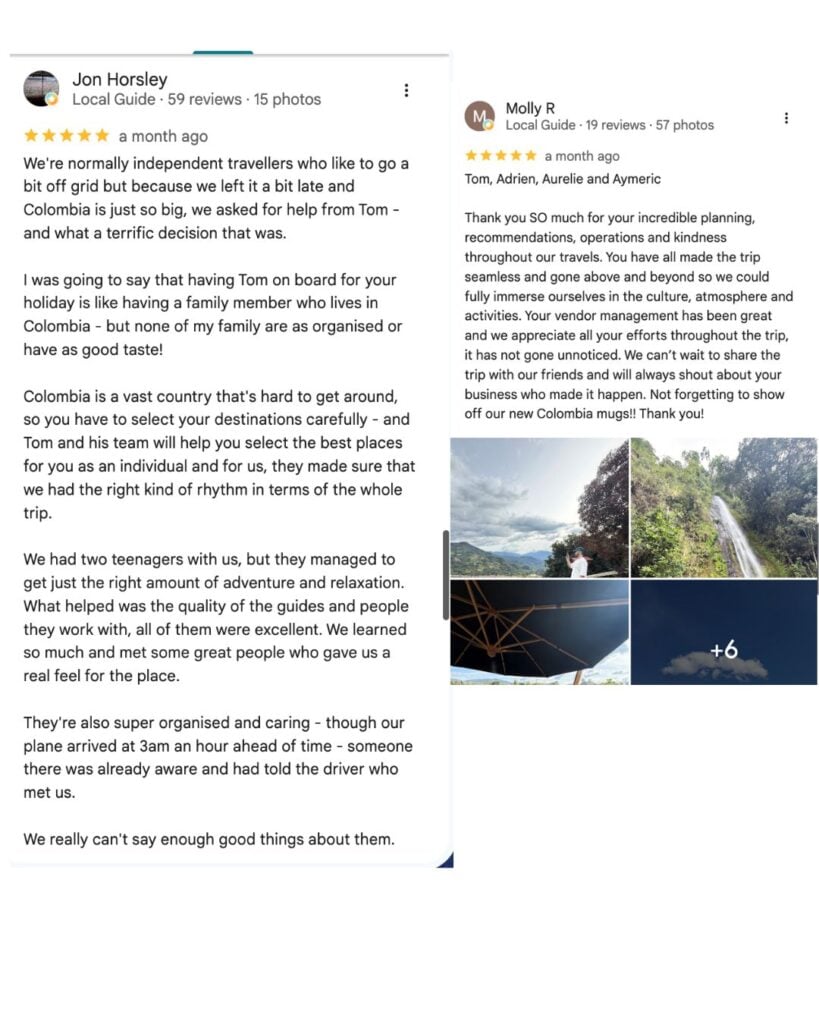
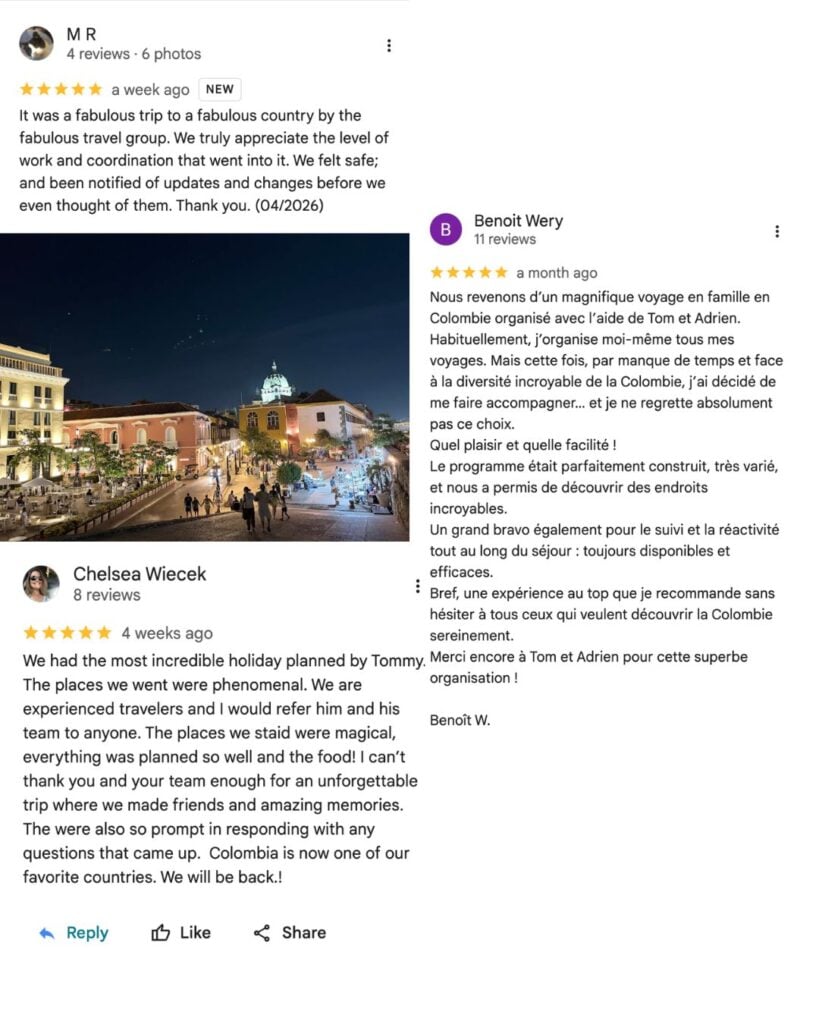



The solution for a successful Colombia trip
“Usually, I don’t go through a travel agency. But for Colombia, I needed help — and this agency transformed my experience in this country.”
That’s the kind of comment you’ll find most often in our reviews (we’ll let you read them 😉).
Let’s explore together for a quality, one-of-a-kind trip that lets you truly connect with the country:
- Undiscovered Colombia — adventures off the beaten path
- Easy Colombia — stress-free, fully comfortable
- Premium Colombia — high-end that stays authentic
What type of trip suits you?
Every trip is unique, but you might see yourself in one of these themes.

EASY
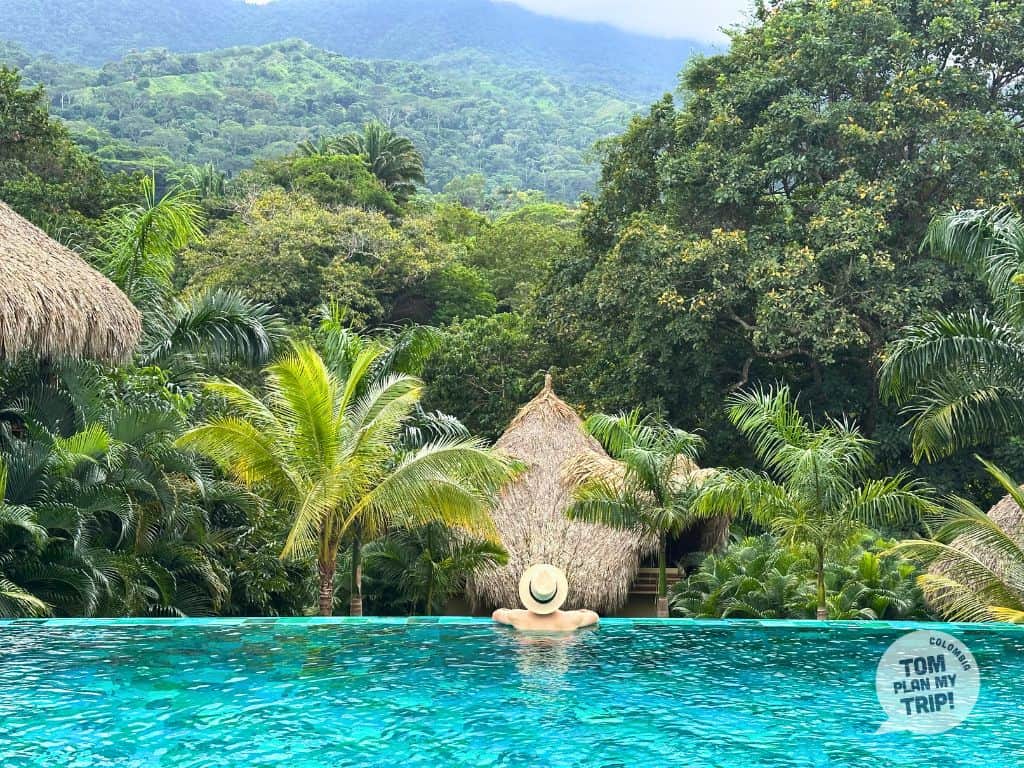
Colombia stress-free, comfortable and at your own pace — Say goodbye to vacations that leave you drained. We design a trip where every day is a pleasure, balancing exploration and relaxation.
PREMIUM
Premium journeys through the heart of Colombia — Comfort, character, authenticity. You shouldn’t have to choose between a luxury experience and a genuine connection with the country. We give you both.
HIDDEN
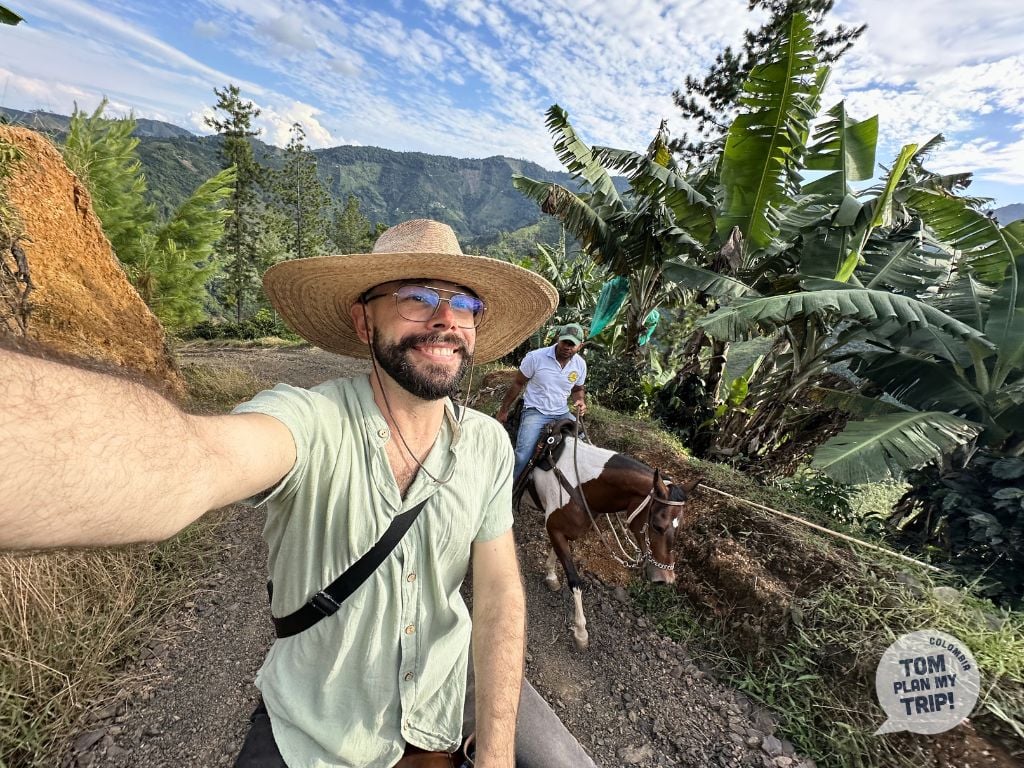
The Colombia beyond the tourist trail — We don’t take you on a tour of Colombia. We immerse you in it, sharing unforgettable moments with your loved ones in stunning places you’d never have discovered on your own.
Learn moreWhat our clients say




Learn more about Colombia
Select a Region of Colombia


Western Caribbean Coast
Colombian Destinations Listed Alphabetically
Places from A to I
Places from J to P
Places from R to Z
Follow us on Instagram!


Our secret to actually enjoying your Colombia vacation
Colombia is twice the size of France. There’s no point trying to see it all in 15 days. Our trips distill 11 years of boots-on-the-ground exploration into the essentials: the very best of the country, without the stress of racing around.
